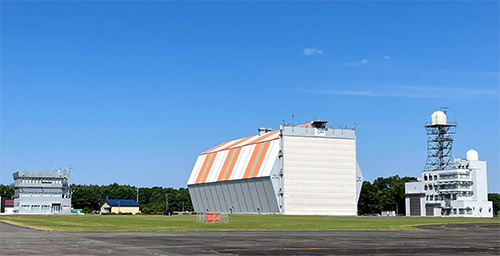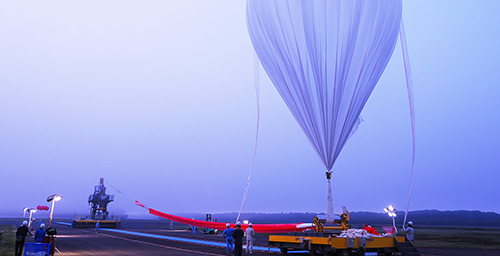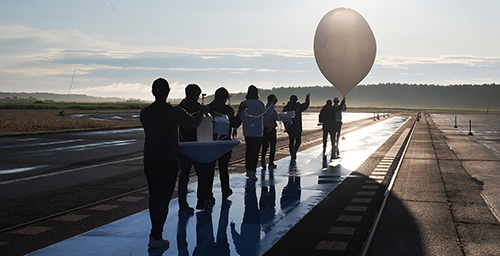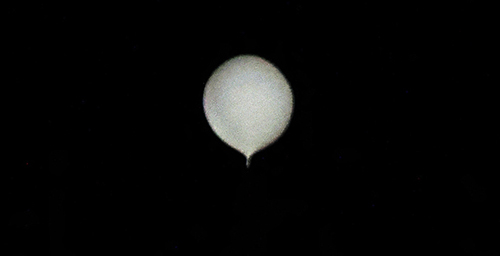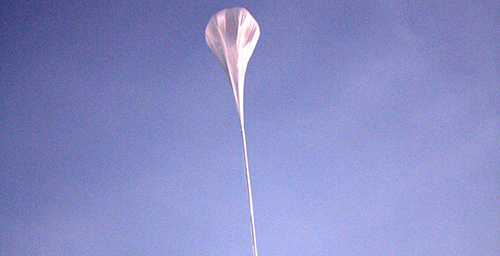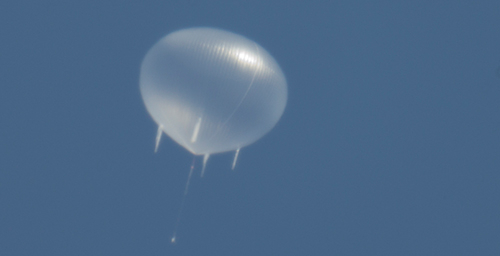


The Japan Aerospace Exploration Agency (JAXA) conducted the scientific balloon flight B26-03, as part of the 2026 scientific balloon campaign, at the Taiki Aerospace Research Field. The balloon was launched on 1 September 2026, at 4:35 am JST for the purpose of conducting an advanced attitude control experiment, BACS, for balloon-borne payloads. The polyethylene balloon had a fully inflated volume of 30,000 m3 (diameter 42 m) and ascended at a rate of approximately 230 m per minute.
Approximately 1 hours and 30 minutes after launch, the balloon reached its floating altitude of approximately 21 km over the Pacific Ocean, approximately 100 km east from the Taiki Aerospace Research Field. At 10:55 am JST, the balloon and the onboard equipment were separated by tele-command and slowly descended onto the sea, landing approximately 110 km east from the Taiki Aerospace Research Field, where they were recovered by recovery boats at 0:29 pm JST.
Regarding the balloon-borne attitude control experiment, BACS, further research will now be conducted through the thorough analysis of the data obtained in this flight.
At the time of launch, the ground weather conditions were: weather: cloudy, wind speed: 3 m/s, and temperature: 17 degrees Celsius.
※ Research overview
In research such as astronomical observations using balloons, sophisticated attitude control systems are essential for aligning optical systems such as telescopes with target celestial bodies. By applying and integrating attitude control technologies from past balloon experiments with displacement measurement technologies developed to date, the aim is therefore to realise a high-performance, compact, and lightweight attitude control system that can be applied to a wide range of research, including next-generation astronomical observations using balloons. In this experiment, the coarse attitude control system within the attitude control unit will be equipped, and its performance will be evaluated under balloon-borne conditions. In the future, the plan will be to integrate the coarse attitude control system evaluated in this experiment with the fine attitude control system currently under development. This experiment constitutes the first step towards acquiring fine attitude control technology in the future.

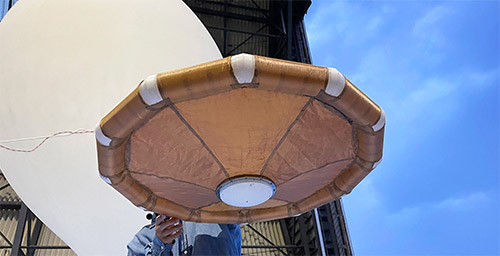
The scientific balloon B26-03 inflated inside the hangar and the BACS0 payload mounted on the launcher. (credit: JAXA)

The scientific balloon B26-03 immediately after launch. (credit: JAXA)