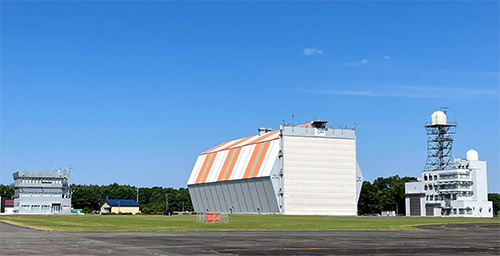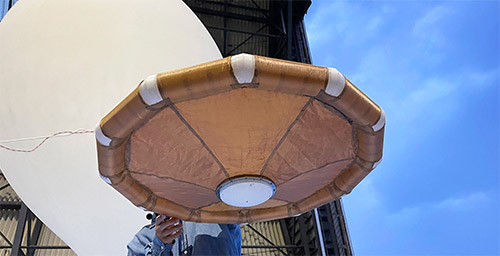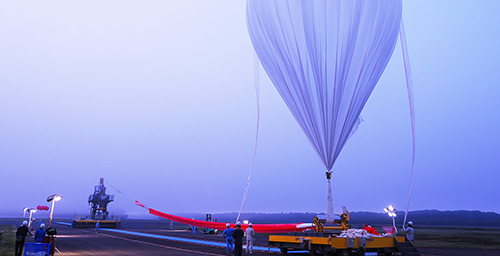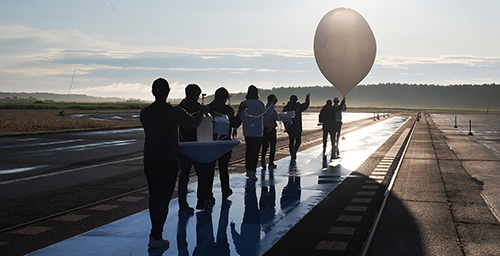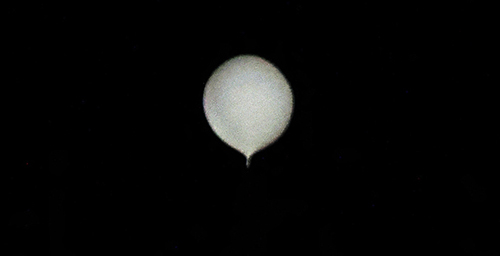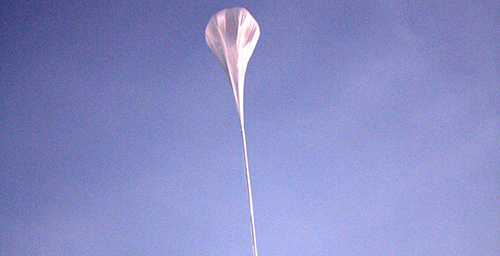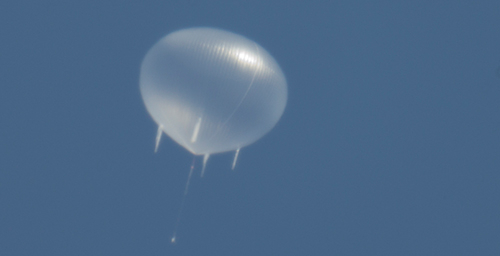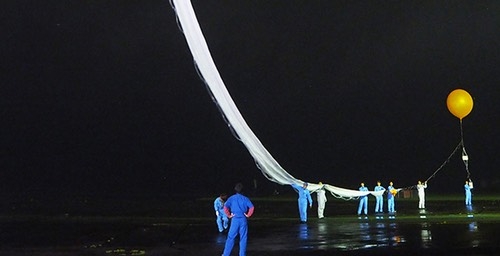


The Japan Aerospace Exploration Agency (JAXA) conducted the scientific balloon flight BS26-03, as part of the 2026 scientific balloon campaign at the Taiki Aerospace Research Field. The balloon was launched on 22 Aug 2026, at 0:00 am JST for an experiment to develop simultaneous balloon and ground-based observation methods for high-energy cosmic-ray air showers to elucidate their origin. The balloon was a rubber balloon with a maximum inflated diameter of 11m, and ascended at a rate of approximately 300 m per minute.
1 hours and 34 minutes after launch, the balloon reached its highest altitude of 28 km over the Pacific Ocean, approximately 25 km east from the Taiki Aerospace Research Field. The balloon and the onboard equipment slowly descended onto the sea, landing approximately 35 km east from the Taiki Aerospace Research Field.
Regarding the CLOVER experiment to develop simultaneous balloon and ground-based observation methods for high-energy cosmic-ray air showers, further research will now be conducted through the thorough analysis of the data obtained in this flight.
At the time of launch, the ground weather conditions were: weather: sunny, wind speed: 1 m/s, and temperature: 19 degrees Celsius.
※Research overview
Elucidating the origin of cosmic rays is one of the most important issues in astrophysics, with the origin expected to differ depending on the energy range. In particular, in the energy range from peta-electronvolts (PeV = 10^15 eV) to exa-electronvolts (EeV = 10^18 eV), the composition of cosmic rays is thought to undergo a transition, and therefore precise measurements of the cosmic-ray composition (types of atomic nuclei) are a key factor in uncovering the origins of these high-energy cosmic rays. Cherenkov radiation emitted directly from cosmic rays (Direct Cherenkov light = DC light) is one of the most promising clues to the composition. However, previous studies have so far only yielded fragmentary information. This study aims to tackle this challenge to enable precise measurements of cosmic-ray composition by comprehensively performing measurements of DC light intensity at balloon altitudes in combination with determining the energy and arrival direction of the cosmic rays using a ground-based detector array. As a first step, this experiment will make the world's first attempt to observe DC light using a compact detector carried by a rubber balloon.

Launch of the scientific balloon flight BS26-03. (credit: JAXA)