


[Mission overview and purpose]
Formation Flying (FF) is the technology to maintain the relative positions between multiple spacecraft, enabling the high-precision observation systems such as long baseline interferometers with its whole size far greater than that of the single spacecraft. SILVIA (Space Interferometer Laboratory Voyaging towards Innovative Applications) is a technology demonstrator that conducts the in-orbit experiments of ultra-precision FF technology at a control precision on the order of a wavelength (μm), which is necessary to realize the future space gravitational wave telescopes and space infrared interferometers.
The mission objective is to demonstrate the FF control technology that maintains the control precision of the laser interferometer baseline length to the order of μm in an equilateral triangular formation and possibly others where three satellites are deployed with the intersatellite distances of about 100m.
[Outcome of the project]
The Space Science and Technology Roadmap mentions the possible implementation of the space gravitational wave telescopes and space infrared interferometer. These are the missions that SILVIA contributes to by providing the ultra-precision FF technology. As SILVIA carries out the technology demonstration by the early 2030’s, the relevant technology can be obtained for the realization of the space gravitational wave telescope (B-DECIGO) and the space infrared interferometer that Japan plans to lead and implement in future. SILVIA will significantly increase the technological feasibility of these subsequent mission concepts.
[Basic data]
Main specifications of the satellite system (under consideration)
・Orbit: Sun-synchronous orbit around the Earth
・Mass: 180kg x 3 satellites
・Launch year: early 2030’s
・Launch vehicle: 3-satellite piggyback launch by Epsilon S.
(Image Credit: JAXA)

FutureSILVIA - Ultra-precision formation flying demonstrator
SILVIA will conduct in-orbit demonstration of the ultra-precision Formation Flying (FF) technology, which is essential for realizing space interferometry, the next generation of high-precision astronomical observation methods. SILVIA aims at acquiring the new technology for future space missions such as gravitational wave telescopes and infrared interferometers.
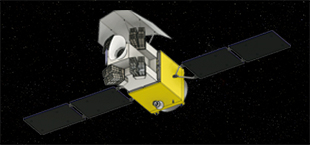 High-z Gamma-ray bursts for Unraveling the Dark Ages Mission (HiZ-GUNDAM)
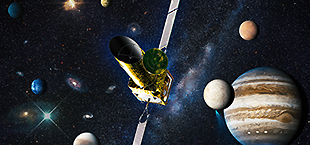 Life-environmentology, Astronomy, and PlanetarY Ultraviolet Telescope Assembly (LAPYUTA)