


In recent years, space explorations successfully provide new discoveries in areas of solar system science, exoplanets, and beyond, thanks to advances in observational technology. “Spectroscopic observation” is a key technology to find new features in planetary atmospheres and gases in space. Ultraviolet spectroscopy, in particular, has gained significant attention as an indispensable technique for a wide range of research. This is because elements universally present in the universe, such as hydrogen, oxygen, and carbon, exhibit characteristic emission and absorption lines in the ultraviolet wavelength range. This makes it essential for studies ranging from understanding of habitable environments in space to investigating the structure and evolution of the universe.
One of the major topics driving space exploration is the question, “What constitutes an environment where life could exist?” Venus and Mars currently have environments too harsh for liquid water on the surfaces, yet they are thought to have once had warm climates and oceans. One key to understanding why these conditions were lost is “atmospheric escape”, the process by which a planet's atmosphere escapes into space. The upper atmosphere surrounding a planet consists of atoms like hydrogen and oxygen, which are bombarded with ultraviolet radiation from the Sun. By observing ultraviolet radiation, we can determine how atmosphere escapes and understand how this process shaped the planet's history.
Jupiter's moons Europa and Ganymede are thought to have oceans under icy crusts and are attracting attention as potential “second habitable environments”. Gases are emitted from the surfaces of these moons, forming a tenuous atmosphere and providing clues to the chemical composition of the moon’s surface.
Beyond our solar system, the discovery of exoplanets has increased rapidly. Many Earth-sized planets have now been found. However, the most crucial question, “Does the planet have an atmosphere?”, still lacks a definitive answer. The atmospheres of Earth-like planets are thin, and difficult to detect using current observation techniques. Ultraviolet observation is expected to play a vital role in detecting these atmospheres as ultraviolet is sensitive to the tenuous but extended atmosphere around the planet.
Ultraviolet observation is also indispensable for studying the structure of the universe, the formation of galaxies, and the distribution of gas that forms stars. The universe contains a variety of phenomena, such as galaxies harboring active black holes at their centers, star formation galaxies, and so on. However, the evolution of these structures is not yet fully understood. Furthermore, fundamental mysteries remain, such as where and how elements heavier than iron were created. Observing the high-temperature gas emitted immediately after neutron star mergers could reveal the backstage of heavy element synthesis in the universe.
In light of these scientific contexts, there is a need for a new ultraviolet space telescope mission. Since ultraviolet light is absorbed by Earth's atmosphere, the telescope must be placed in space. A next-generation ultraviolet telescope, equipped with a large aperture and high-precision spectrograph, is expected to provide answers to critical questions highlighted above. The next-generation ultraviolet telescope will open a new door, unlocking a host of mysteries across the universe.
(Image Credit: TOHOKU University / JAXA)
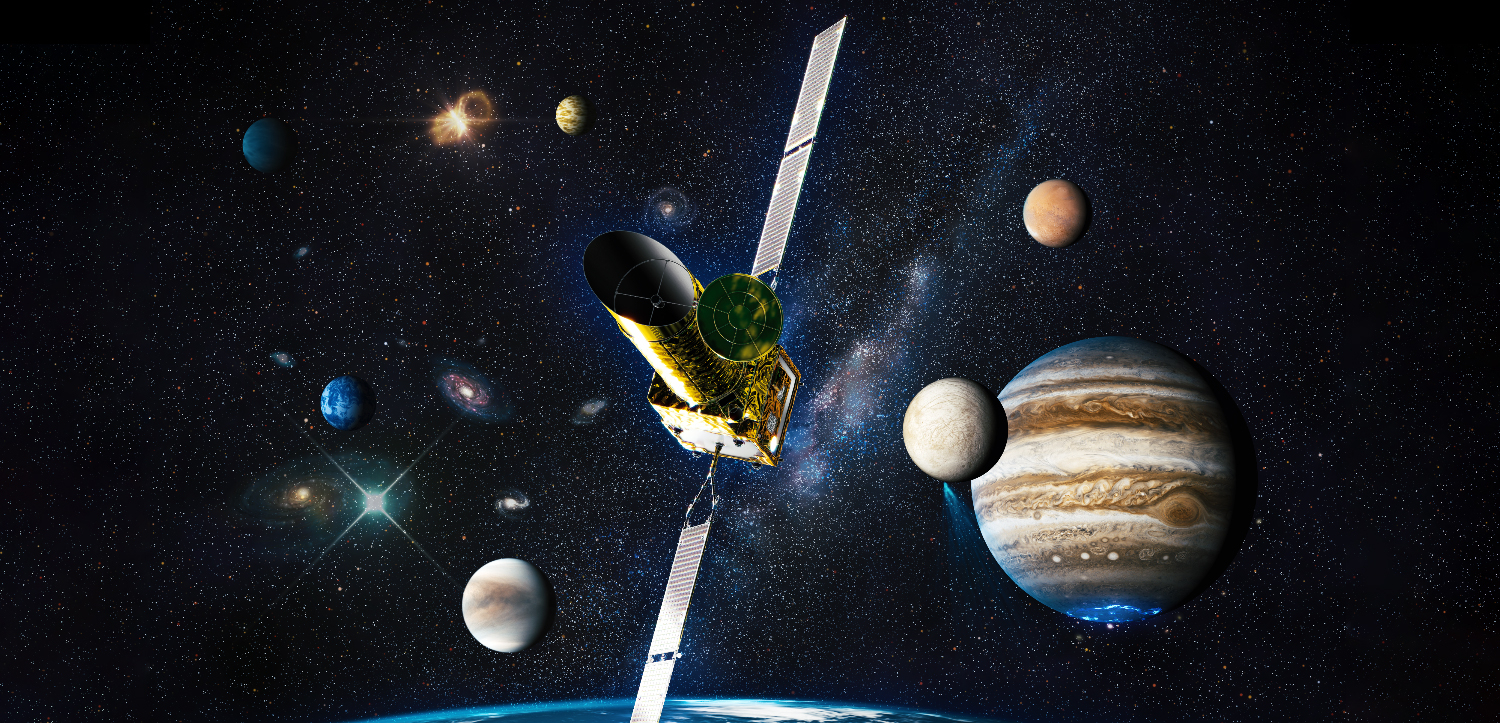
FutureLife-environmentology, Astronomy, and PlanetarY Ultraviolet Telescope Assembly (LAPYUTA)
Toward two science goals: “Life habitable environments in the planetary system” and “Origin of space and material in the universe”, LAPYUTA will address the following four objectives through ultraviolet observations: (1) Habitable environments in the solar system, focusing on icy moons in the Jupiter system and atmospheric evolution of terrestrial planets like Venus and Mars, (2) Characterization of exoplanet atmospheres around the habitable zone, (3) Formations of present-day galaxies, and (4) Synthesis process of heavy elements.
 SILVIA - Ultra-precision formation flying demonstrator