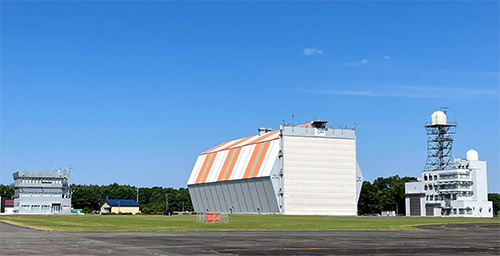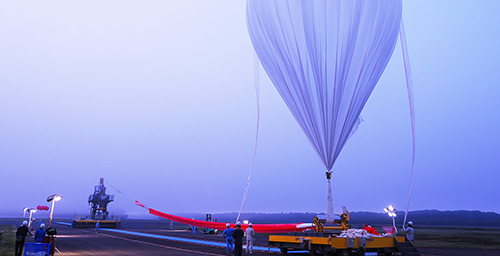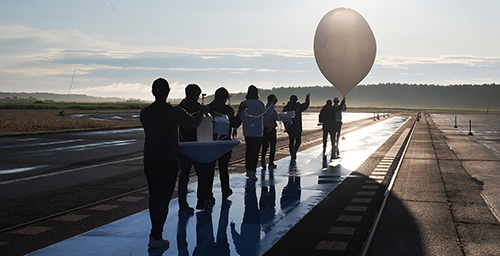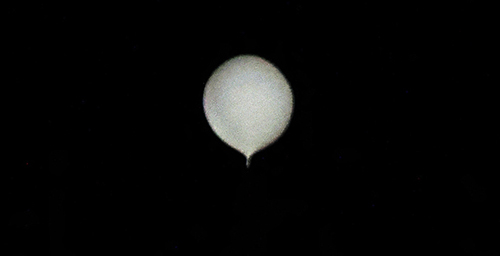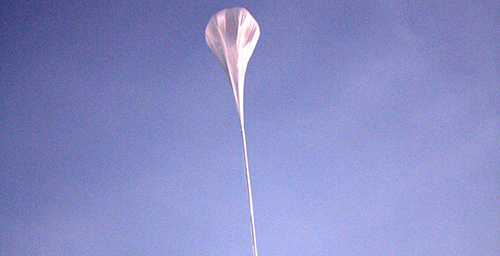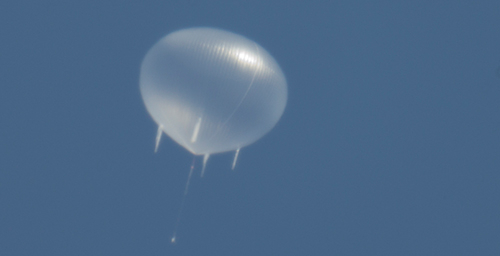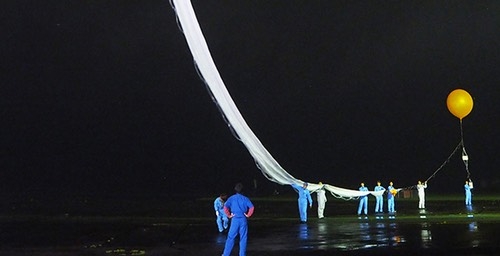


The Japan Aerospace Exploration Agency (JAXA) conducted the scientific balloon flight BS26-02, as part of the 2026 scientific balloon campaign, at the Taiki Aerospace Research Field. The balloon was launched on 2 July 2026, at 3:30 am JST for the purpose of conducting a free-flight experiment to test the performance of a flexible aerodecelerator. The balloon was a rubber balloon with a maximum inflated diameter of 11m, and ascended at a rate of approximately 360 m per minute.
1 hours and 25 minutes after launch, the balloon reached its highest altitude of 31 km over the Pacific Ocean, approximately 40 km east-southeast from the Taiki Aerospace Research Field. The test equipment slowly descended onto the sea, landing approximately 80 km east-southeast from the Taiki Aerospace Research Field.
Regarding the free-flight experiment of the flexible aerodecelerator, further research will now be conducted through the thorough analysis of the data obtained in this flight.
At the time of launch, the ground weather conditions were: weather: cloudy, wind speed: 1 m/s, and temperature: 13 degrees Celsius.
※ Research overview
The flexible aerodecelerator is a new atmospheric entry technology currently under research and development whose design offers several advantages: employing a lightweight, large-area fabric structure enables low ballistic coefficient flight, thereby achieving efficient aerodynamic deceleration at high altitudes, reducing aerodynamic heating, and allowing parachute-free descent to the ground at speeds comparable to those achieved with parachutes. For this development, key issues include obtaining the aerodynamic characteristics of the aerodecelerator and understanding its aerodynamic instabilities, including shape deformation of the flexible structure due to the aerodynamic forces. Data acquisition through free flight is indispensable as a complementary method to wind tunnel tests and numerical analysis. This experiment builds on the free-flight experimental methodology developed through six previous balloon flights conducted since 2022 to conduct tests of the flexible aeroshell with modified centre-of-gravity characteristics compared to conventional designs, and evaluate the effect of varying design parameter choices on the characteristics of the aerodecelerator.

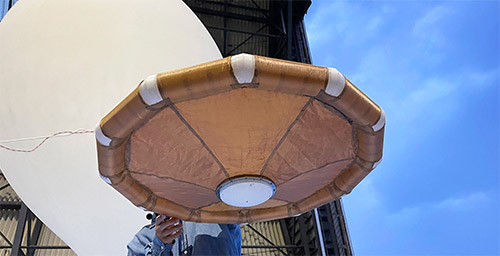
The flexible aerodecelerator awaiting its launch. (credit: JAXA)

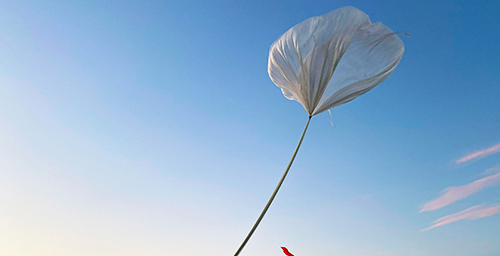
Ascending rubber balloon BS26-02 and the flexible aerodecelerator. (credit: JAXA)