

Key Points
- Using powerful high-resolution spectroscopic capabilities of the X-ray Imaging and Spectroscopy Mission (XRISM), we have, for the first time, directly measured the velocity spread of hot gas in the central region of the starburst galaxy*1 M82.
- The measured spread is larger than previously predicted, suggesting that most of the energy from supernova explosions*2 is stored in hot gas.
- This hot gas moves at high speed while entraining surrounding material, and a fraction of it may escape the galaxy's gravitational potential and reach intergalactic space.
- These results reveal both the processes by which material remains within galaxies and those by which it flows out, providing new insights into galaxy evolution and the matter cycle in the Universe*3.
Abstract
In starburst galaxies, numerous supernova explosions associated with intense star formation heat the gas in the central regions to temperatures high enough to emit X-rays. This hot gas acts as the driving source, pushing and entraining surrounding material to produce a fast outflow (a galactic wind*4; see Fig. 1). This flow can include components that remain within the galaxy, as well as components that escape into intergalactic space. Such flows transport matter and energy―including heavy elements produced inside stars―between the interior and exterior of galaxies and play an important role in galaxy evolution and the matter cycle in the Universe. However, previous observations have mainly traced the motion of entrained material, and direct measurements of the motion of the driving hot gas have been difficult. Consequently, it has remained a long-standing challenge to observationally determine how much supernova energy is stored in hot gas and how much material is driven out of galaxies.
In this study, the XRISM Collaboration precisely measured the velocity spread of hot gas in the central region of the starburst galaxy M82. We found that the hot gas exhibits a larger velocity spread than predicted, indicating that most of the energy from supernova explosions is likely stored in hot gas. Furthermore, this hot gas moves at high speed while entraining surrounding material, driving an outflow consisting of components with a wide range of temperatures and physical states. A fraction of the remaining hot gas may escape the galaxy's gravitational potential and reach intergalactic space.
These results provide a quantitative basis for understanding how gas motions driven by starburst activity contribute to the transport of matter within and beyond galaxies. This is expected to advance our understanding of galaxy evolution and the matter cycle in the Universe.
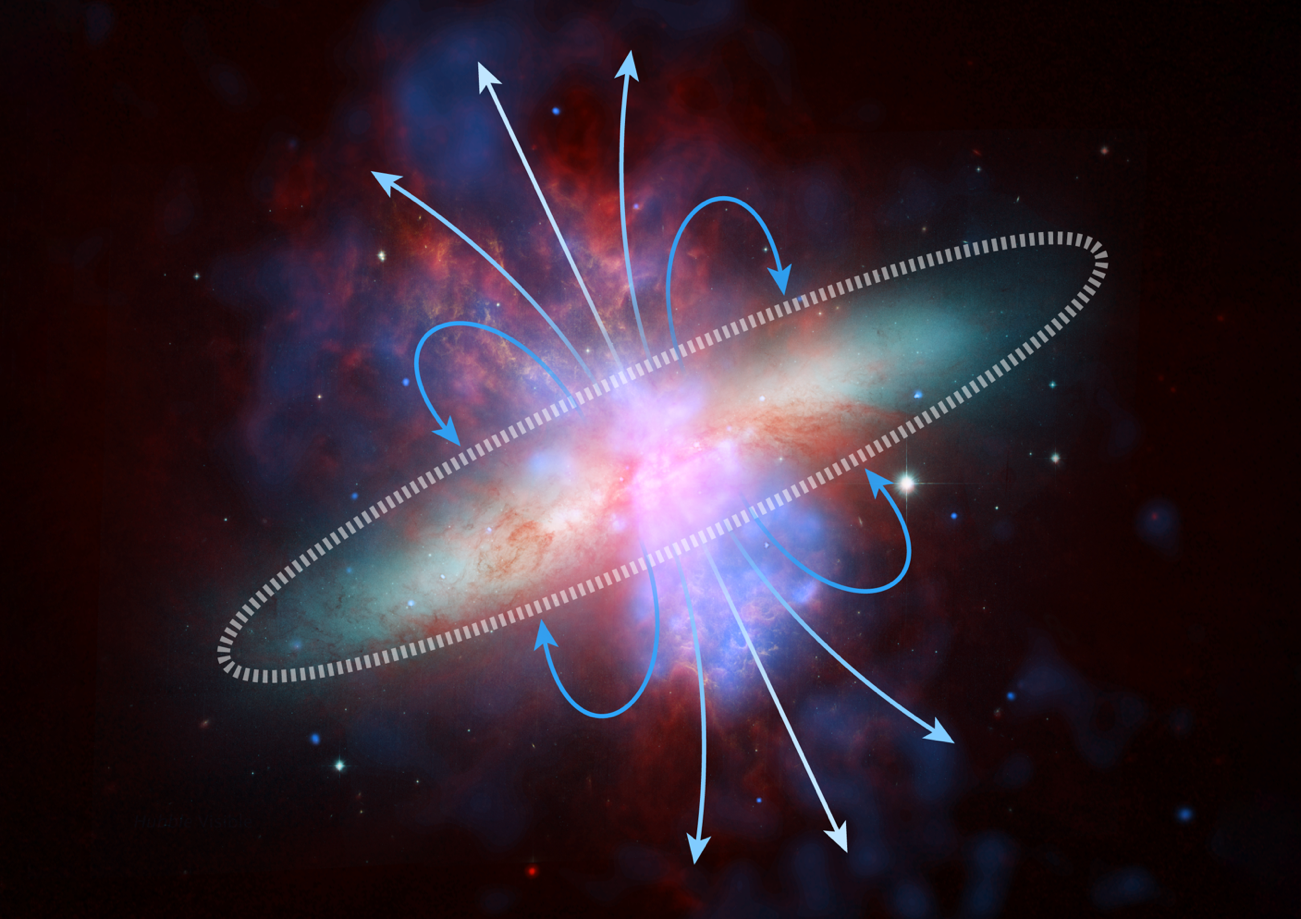
Figure 1: A multiwavelength view of the starburst galaxy M82, illustrating hot gas originating in the central region and expanding on galactic scales while entraining surrounding material. Arrows indicate the direction of the gas flow. Blue represents X-rays (NASA/CXC/JHU/D. Strickland), green and orange represent optical light (NASA/ESA/STScI/AURA/The Hubble Heritage Team), and red represents infrared emission (NASA/JPL-Caltech/University of Arizona/C. Engelbracht), tracing material at different temperatures and physical states. The dashed lines indicate the galactic disk.
Main Text
Background
The Universe contains countless galaxies, and large amounts of heavy elements are known to exist in intergalactic space. Since these elements are produced inside stars, they must originally have resided within galaxies. However, the mechanism by which they are transported out of galaxies remains a major open question.
A leading candidate to explain this process is a fast, galaxy-scale outflow of material spanning a wide range of temperatures and physical states, known as a galactic wind. In starburst galaxies, intense star formation leads to numerous supernova explosions over short timescales. These explosions heat the interstellar gas to high temperatures, producing hot, high-pressure gas that entrains surrounding material, breaks out of the galactic disk, and expands both within and beyond the galaxy.
However, direct measurements of the motion of the hot gas that drives galactic winds have been difficult. In particular, probing the dynamics of X-ray-emitting gas at tens of millions of degrees requires high-resolution X-ray spectroscopy.
Observation Results
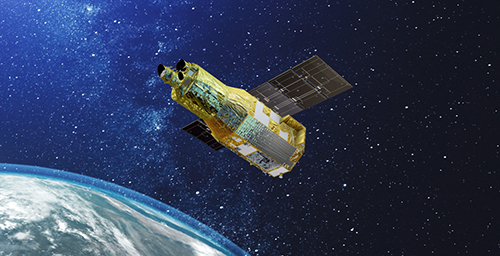
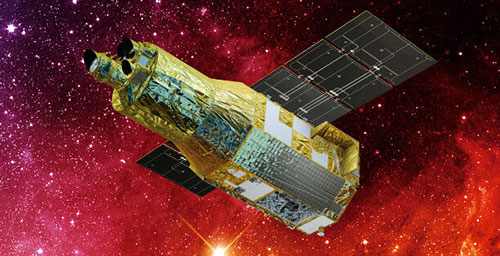
Using the high-resolution soft X-ray spectrometer Resolve onboard XRISM, we observed the central region of M82―a nearby (approximately 12 million light-years away) representative starburst galaxy―in May 2024. From the spread of X-ray emission lines emitted by gas at temperatures of about 20 million degrees, we found that the gas exhibits a velocity spread of approximately ±600 km/s along the line of sight (see Fig. 2).
This result indicates that the hot gas carries more kinetic energy than previously expected, suggesting that most of the energy from numerous supernova explosions is stored in the hot gas. Furthermore, we found that about 60% of this energy is likely used to accelerate cooler material―such as molecular, neutral, and ionized gas―thereby driving a galactic wind composed of material in a wide range of temperatures and physical states. The remaining hot gas may escape the galaxy's gravitational potential and flow out into intergalactic space.
These results suggest that galactic winds can be driven solely by hot gas heated by supernova explosions, without requiring additional energy input such as cosmic rays.
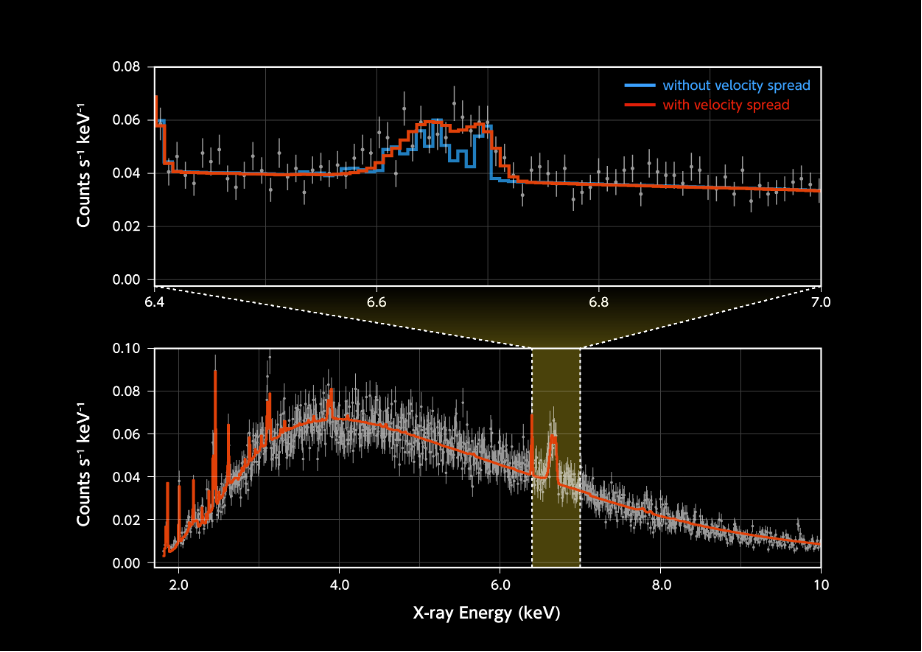
Figure 2: X-ray spectrum of the central region of the starburst galaxy M82 obtained with XRISM/Resolve. The upper panel shows a close-up around the iron emission lines, and the lower panel shows the full spectrum. Black points represent the observed data, and the curves represent model fits. The blue curve shows a model without velocity spread, while the red curve includes a line-of-sight velocity spread of approximately ±600 km/s. The observed line spread is well reproduced by the model that includes velocity spread.
Prospects
M82 is a nearby, representative starburst galaxy and an ideal target for studying the physics of this phenomenon. However, the triggers and scales of starburst activity vary among galaxies. Future observations of other starburst galaxies will enable us to assess more generally how such processes contribute to the matter cycle in the Universe.
Glossary
*1 Starburst galaxy
A galaxy exhibiting an exceptionally high rate of star formation. Large numbers of massive stars are formed over short timescales, leading to frequent supernova explosions.
*2 Supernova explosion
A large-scale explosion that occurs at the end of the life of a massive star. It releases heavy elements produced inside the star into space and injects a large amount of energy into the surrounding material.
*3 Matter cycle
The flow of matter involving transport both within and beyond galaxies. It plays an important role in galaxy evolution and the distribution of matter throughout the Universe.
*4 Galactic wind
A fast, galaxy-scale flow of material spanning a wide range of temperatures and physical states, driven by hot gas produced by numerous supernova explosions, which entrains surrounding material and expands both within and beyond the galaxy.
Publication Information
Journal: Nature
Title: A fast starburst wind consumes most of the energy from supernovae
Author: XRISM Collaboration
DOI: 10.1038/s41586-026-10231-1