

Abstract
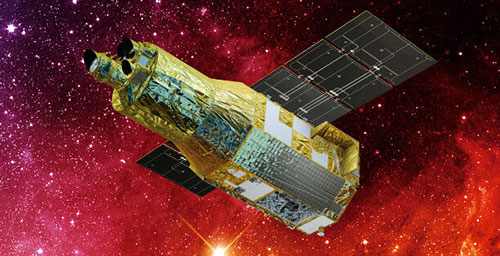
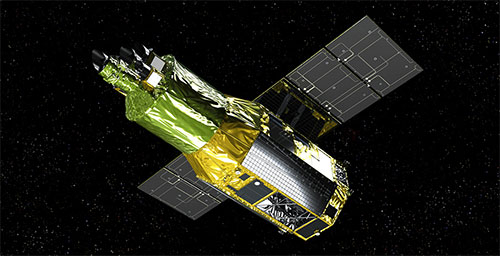
The centers of galaxies hold crucial clues to how stars form and die, and how matter accretes onto black holes. Yet their elemental composition has remained poorly constrained due to the limited precision of past observations. The X-ray Imaging and Spectroscopy Mission (XRISM) has now observed the region around the supermassive black hole at the center of the Compass Galaxy, about 13 million light-years away, measuring its composition with unprecedented precision. By resolving faint fluorescence X-ray lines from multiple elements, XRISM reveals how massive stars enrich the environment around black holes, offering new insight into the life cycle of matter in extreme conditions. The results were published online on March 31, 2026, in the British international academic journal Nature Astronomy, highlighting XRISM's unique capability for high-resolution X-ray spectroscopy.

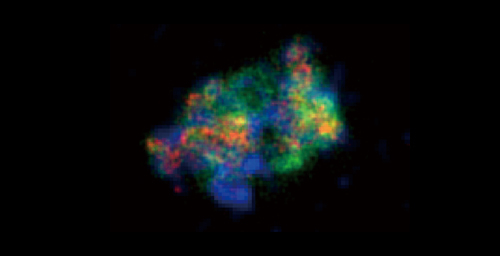
Figure 1: Artist's illustration (inset). The central region of the Compass Galaxy. Intense, continuous X-rays (white) from the hot corona around the supermassive black hole (black circle) irradiate the surrounding doughnut-shaped ring of gas and dust (torus), producing fluorescent X-rays from many elements (Credit: JAXA). Background: Visible-light Hubble Space Telescope image of the full Compass Galaxy (Credit: NASA, ESA).
Background: Exploring the Chemical History of Galactic Centers and the Fate of Stars
To understand how supermassive black holes at the centers of galaxies grow and interact with their surroundings, it is essential to investigate the elemental composition--that is, the types and abundances of elements--of the gas in their vicinity. Most elements heavier than hydrogen and helium are synthesized inside stars and released into the surrounding medium by supernova explosions. The amount and pattern of elements produced depend strongly on the type of supernova (core-collapse or Type Ia; Note 1) and on the mass of the progenitor star. By measuring the elemental composition, we can therefore reconstruct the "galactic history," revealing what kinds of stars formed in the past and how they ended their lives.
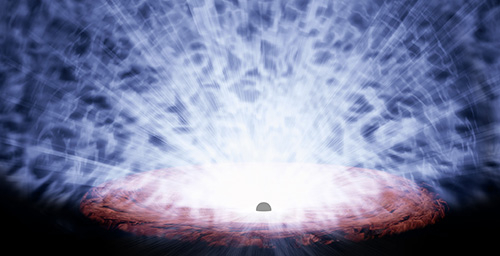
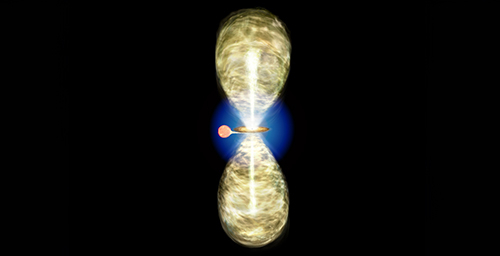
However, the central regions of galaxies are often heavily obscured by dense gas and dust, making them difficult--or in many cases impossible--to observe in visible light. In addition, emission observed at optical wavelengths is typically complex, and its interpretation can be highly uncertain. In contrast, X-rays have strong penetrating power, and the physical processes governing their interaction with matter are relatively simple and well understood. In the vicinity of actively accreting supermassive black holes (active galactic nuclei; Note 2), a high-temperature corona reaching about one billion Kelvin produces intense, continuous X-ray emission. When this radiation illuminates the surrounding material, it induces fluorescent X-ray emission at energies characteristic of the constituent elements (Figure 2).

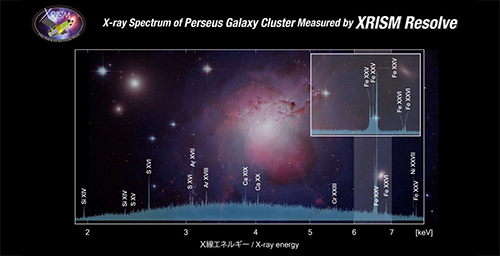
Figure 2: (Bottom) X ray energy spectrum of the central nucleus of the Compass Galaxy, measured with XRISM/Resolve (both axes in logarithmic scale). Distinct fluorescent X ray lines from Ar, Ca, Cr, Mn, Fe, and Ni are visible. (Top) Zoomed view around the iron emission complex in the same spectrum (logarithmic vertical axis only). The broad feature to the left of the main iron peak (the Compton shoulder) arises from iron fluorescent X rays scattered by distant electrons. Modeling these line profiles shows that the fluorescence originates in a cold, metal-rich torus of gas and dust.
By measuring the intensities of these fluorescent X-rays, we can accurately determine the elemental composition. However, conventional X-ray observatories lacked sufficient energy resolution to clearly distinguish these faint fluorescence lines from other emission features. As a result, the detailed chemical composition in the vicinity of galactic central black holes remained poorly constrained for many years, awaiting an observatory with the spectroscopic capability of XRISM.
Observation and Results
The soft X-ray spectrometer Resolve aboard XRISM can measure X-ray energies with unprecedented precision, far surpassing previous X-ray observatories. The research team selected the Circinus Galaxy (Figure 1)―one of the nearest active galactic nuclei and a bright source of iron fluorescence X-rays―as their target, and conducted deep observations totaling approximately 300,000 seconds. Thanks to its superb spectral resolution and stable calibration, XRISM successfully resolved and detected fluorescent X-ray emission from multiple elements--including iron (Fe), nickel (Ni), argon (Ar), calcium (Ca), chromium (Cr), and manganese (Mn)--that had previously appeared blended together in observations by earlier missions (Figure 2).
These measurements enable precise determination of the temperature and spatial distribution of the gas surrounding the black hole, as well as its detailed elemental composition. While X-ray fluorescence analysis is widely used in laboratory settings on Earth with artificial X-ray sources, this study is groundbreaking in applying the same technique to the distant universe using natural X-ray illumination from a supermassive black hole--something only a high-resolution mission like XRISM can achieve.
Analysis of the data led to the following key findings:
- Locating the Gas: The shape of the iron fluorescence line indicates that the emitting material resides in a cold, metal-rich structure known as a torus, located more than 0.08 light-years (approximately 740 billion kilometers) from the black hole. This provides direct evidence of gas in the final stages before being accreted onto the supermassive black hole.
- Unique Elemental Composition: The most striking result is the relative abundance pattern of elements (Figure 3). Compared to the composition near the Solar System, argon and calcium are underabundant relative to iron, while nickel is enhanced. Comparison with theoretical models―based on combinations of different supernova types and rates―suggests that this pattern can be naturally explained if the gas was supplied by relatively recent star formation, and if, in metal-rich environments, a significant fraction of stars more massive than about 20 solar masses collapse directly into stellar-mass black holes without exploding as supernovae (Figure 4).

Figure 3: Data points (with error bars) show the measured abundance ratios of argon, calcium, chromium, manganese, and nickel relative to iron in the central region of the Compass Galaxy. The thick green line indicates the best-fit theoretical model (blue: contribution from white dwarf supernovae; orange: from core-collapse supernovae). The thin green line shows a model assuming the explosion of a star 20 times the Sun's mass, which overproduces argon and calcium compared with the observations.
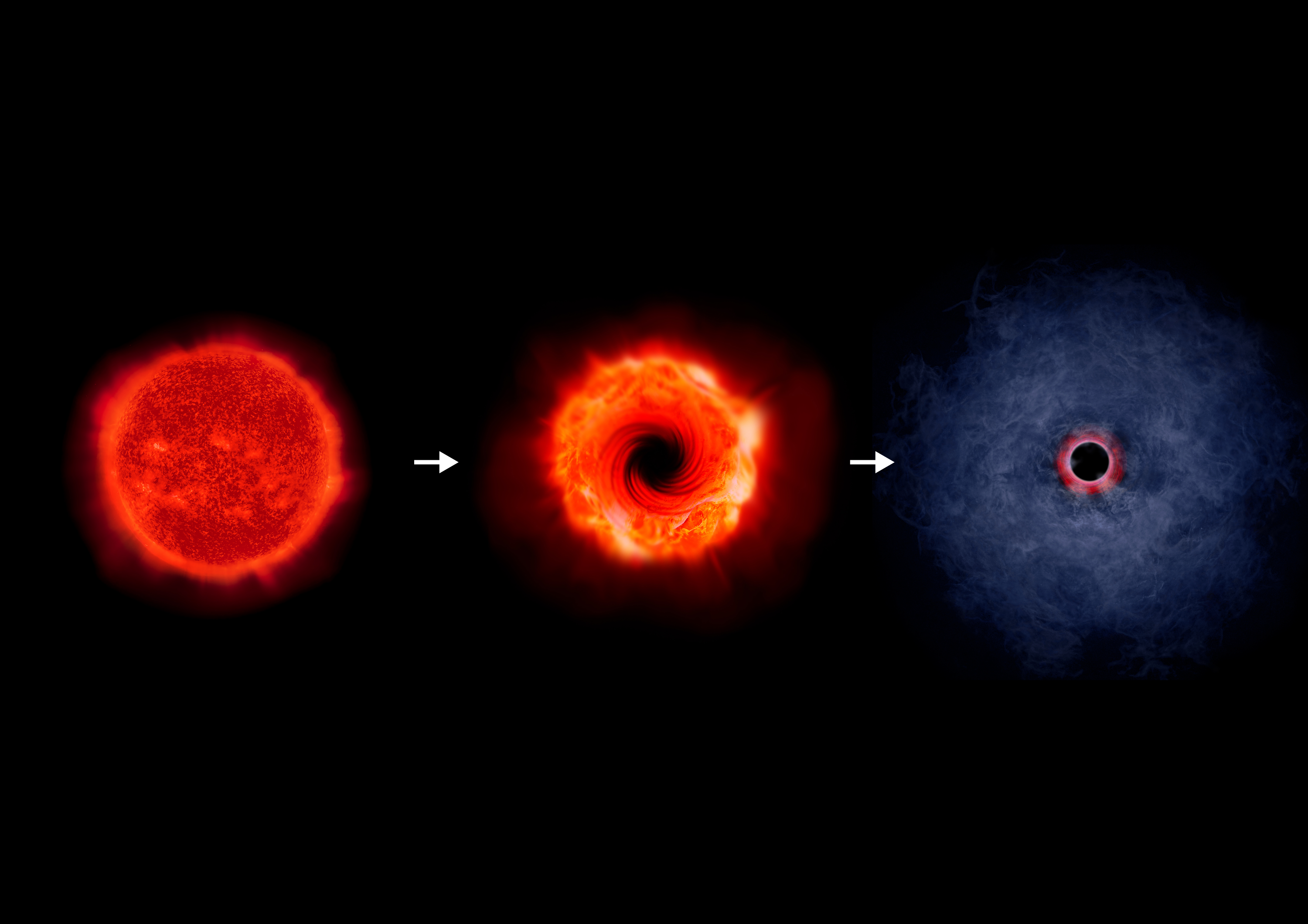
Figure 4: An illustration of the final evolutionary stages of a star more than 20 times the mass of the Sun (left → center → right). Left: Red supergiant phase. Center: The core collapses under gravity but fails to produce a supernova explosion. Right: Heavy elements such as calcium and argon (red) are swallowed by the newly formed black hole (black circle at the center). (Credit: JAXA)
This study establishes a scenario in which active galactic nuclei are continuously fueled by gas produced during recent episodes of star formation and stellar death. It provides a direct glimpse of the co-evolution of supermassive black holes and their host galaxies. Furthermore, while the direct collapse of massive stars into stellar-mass black holes without a supernova explosion has long been predicted theoretically, this study provides some of the strongest observational evidence to date based on elemental abundance patterns revealed by XRISM's high-resolution spectra. Massive stars that may undergo such direct collapse include red supergiants, which have initial masses exceeding about 20 times that of the Sun and are known to exist in our own Milky Way. However, supernovae with such massive red supergiant progenitors have rarely been observed in the nearby universe, a discrepancy known as the "red supergiant problem." The abundance pattern measured in this study offers a natural explanation for this long-standing issue. These results represent a significant step forward in understanding the cycle of matter in the universe and the formation pathways of black holes, and highlight XRISM as a uniquely powerful observatory for tracing how elements flow from stars into black holes.
Future Prospects
This study highlights the power of high-precision X-ray spectroscopy for uncovering the history of element formation in the universe, and demonstrates that XRISM is opening a new window on the chemical evolution of galactic centers. Looking ahead, we will extend this approach to a wider range of active galactic nuclei to explore how the origin of gas in galactic centers varies with galaxy properties. By assembling a comprehensive sample of XRISM observations, we aim to uncover how supermassive black holes and their host galaxies co-evolve over cosmic time.
Glossary
(Note 1)
Core-collapse supernova: A supernova that occurs when the core of a massive star collapses under its own gravity at the end of its life.
Type Ia supernova: A supernova that occurs when a white dwarf accretes matter from a companion star or merges with another white dwarf, eventually exceeding its critical mass and triggering a thermonuclear explosion.
(Note 2)
Active galactic nucleus (AGN): A region at the center of a galaxy where gas accretes onto a supermassive black hole, releasing gravitational energy and producing intense emission across a wide range of wavelengths, including X-rays.
Publication Information
Title: Accurate Determination of Chemical Abundances near a Supermassive Black Hole
Journal: Nature Astronomy
Authors: XRISM collaboration (Corresponding Authors:Yoshihiro Ueda, Ryosuke Uematsu, Shoji Ogawa, Kotaro Fukushima)
DOI: 10.1038/s41550-026-02817-6