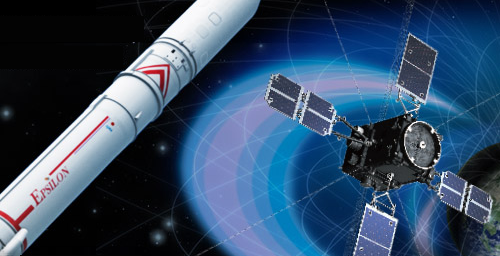
~ Extreme Plasma Mass Enhancement During the Storm Main Phase Revealed by Arase and Ground-Based Observations ~
Key Points
- An international research group led by Kyushu University found that plasma mass in the inner magnetosphere very close to Earth increased rapidly during the main phase of the May 2024 geomagnetic superstorm, with O⁺ potentially accounting for more than 90% of the plasma ions.
- By combining electron number density calculated from Arase's plasma wave data with plasma mass density estimated from geomagnetic data obtained in New Zealand and other regions, the team estimated the average ion composition of the plasma as a whole, including low-energy plasma that is difficult to detect using satellite particle measurements alone.
- JAXA's Arase satellite observed the coexistence of cold and warm plasma, suggesting that heating transferred from the magnetosphere to the ionosphere during geomagnetic superstorms may promote rapid O⁺ supply to the inner magnetosphere. Ionospheric observations from U.S. Defense Meteorological Satellite Program (DMSP) satellites and Global Navigation Satellite System further indicated conditions favorable for ionospheric heating.
- This study indicates that heavy ions can be rapidly supplied to the inner magnetosphere during the main phase of geomagnetic superstorms, unlike the previously recognized O⁺ supply during the recovery phase. The finding is important for understanding variations in the space environment and improving future space weather forecasts.
Keywords
Arase satellite, geomagnetic superstorm, Mother's Day Storm, inner magnetosphere, plasmasphere, oxygen ions, ionosphere, space weather
Background
When a large amount of energy is transferred from the solar wind into Earth's magnetosphere, it can cause a major disturbance known as a geomagnetic storm*¹. Particularly strong storms can cause auroras at low latitudes and affect satellites, communications, and positioning systems. The region extending to roughly eight Earth radii is called the inner magnetosphere and contains plasma composed of electrons and various ion species, including hydrogen ions (H⁺), helium ions (He⁺), and oxygen ions (O⁺), originating from the solar wind and Earth's atmosphere. Although H⁺ usually constitutes the majority of ions, O⁺ can become as abundant as H⁺ during geomagnetic storms. Because O⁺ is 16 times heavier than H⁺, even a small proportion of O⁺ ions can substantially increase the mass density of magnetospheric plasma and influence the propagation of electromagnetic waves and the dynamics of high-energy particles. Regions containing enhanced concentrations of O⁺ have previously been observed as oxygen toruses*², which typically form during the storm recovery phase at geocentric distances of approximately 3-5 Earth radii. As a storm develops, the outer part of the plasmasphere*³ is stripped away. During the subsequent recovery phase, the eroded plasmasphere is gradually refilled with plasma supplied upward from the topside ionosphere. This process is thought to create regions where low-energy plasma supplied from the ionosphere coexists with higher-energy plasma, resulting in enhanced concentrations of ionospheric heavy ions. However, superstorms such as the event investigated here occur only once every few decades, providing extremely limited opportunities for satellites to observe the inner magnetosphere in detail during such events. Consequently, changes in plasma density and composition in the inner magnetosphere during geomagnetic superstorms have remained poorly understood.
Observing the May 2024 Geomagnetic Superstorm from the Ground and Space
On 10-11 May 2024, multiple coronal mass ejections triggered one of the most intense geomagnetic storms of the past two decades. During this storm, the SYM-H index*⁴, a measure of geomagnetic storm intensity, fell to −518 nT, and auroras were observed across a wide area of Japan.
The research group led by Research Associate Professor Obana Yuki of Kyushu University's International Research Center for Space and Planetary Environmental Science first analyzed data from ground-based magnetometers in New Zealand, Europe, and North America. Earth's magnetic field lines oscillate at characteristic frequencies, much like vibrating strings. The greater the mass of the plasma distributed along a field line, the lower the frequency of its resonant oscillation. This property allows plasma mass density in space to be estimated from small magnetic field oscillations measured on the ground. The results showed a rapid increase in plasma mass density along field lines connected to New Zealand several hours after the storm began. The enhancement occurred very close to Earth, at altitudes of approximately 7,500-10,000 km (geocentric distances of approximately 2.1-2.4 Earth radii). The maximum density reached approximately 35,000 amu/cm³ (amu: atomic mass unit. The hydrogen ion has a mass of about 1 amu) at a geocentric distance of approximately 2.1 Earth radii, about ten times its usual level (Figure 1). As time progressed, increases in mass density were observed not only along field lines connected to New Zealand but also along those connected to Europe and eastern North America, indicating that the enhancement extended over a broad region.

Figure 1: Enhancement of plasma mass density observed during the May 2024 geomagnetic superstorm. Results are shown for multiple station pairs in the New Zealand ground-based magnetometer network: MDM-EYR, EYR-WAI, WAI-OAK, and OAK-DON. During the evening of 10 May 2024 (Universal Time), plasma mass density in near-Earth space increased rapidly. An extraordinarily high mass density of approximately 35,000 amu/cm³ was observed for the WAI-OAK station pair. The interval enclosed by dashed lines indicates the period during which average ion mass was estimated by combining these measurements with electron density observations from Arase. (Adapted from Obana et al., 2026.)
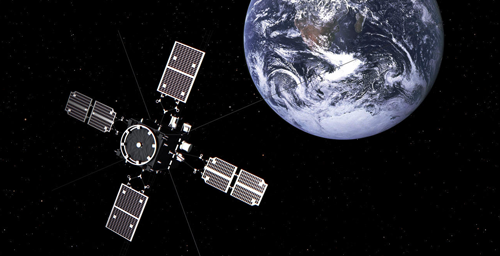
At this time, the JAXA's Arase satellite (a mission to examine the high energy radiation belts around the Earth) was passing through a region connected to nearly the same magnetic field lines as the ground observation sites in New Zealand. The Plasma Wave Experiment (PWE)*⁵ onboard Arase can determine the local electron number density by observing characteristic plasma waves known as upper hybrid resonance (UHR) waves*⁶. Combining the mass density obtained from ground-based magnetometers with the electron number density obtained from Arase allows us to estimate the average mass per ion in the region. The results showed that the average ion mass reached approximately 15 amu. Assuming that the principal ions were H⁺, He⁺, and O⁺, the estimated average ion mass corresponds to an extreme composition in which O⁺ accounted for more than 90% of the ions (Figure 2).

Figure 2: Estimated average ion mass in the inner magnetosphere during the geomagnetic superstorm. The average ion mass was estimated by combining plasma mass density derived from ground-based magnetometer observations with electron density observations from Arase. At geocentric distances of approximately 2.1-2.4 Earth radii, the average ion mass reached approximately 15 amu, suggesting that oxygen ions (O⁺) may have accounted for more than 90% of the plasma ions. This indicates an extreme state in which O⁺ constituted the overwhelming majority of the ions. (Adapted from Obana et al., 2026.)
In previously reported oxygen toruses, O⁺ typically accounts for several tens of percent of the ions, although cases in which its abundance is comparable to or greater than that of H⁺ have also been reported. These structures are primarily observed during the storm recovery phase at geocentric distances of approximately 3-5 Earth radii. In contrast, our results show that a region very close to Earth can become extremely enriched in O⁺ within a short time during the main phase, when the storm is developing most intensely.
Why Were Large Quantities of Oxygen Ions Transported into Near-Earth Space?
What caused such an unusual region to form? Arase's observations showed that remarkably strong magnetospheric convection*⁷ during the May 2024 superstorm caused the plasmasphere to shrink to approximately L ≈ 2.5, meaning that its outer edge moved inward to about 2.5 Earth radii from Earth's centre at the magnetic equator. Near its outer edge, cold, dense plasmaspheric plasma coexisted with warm plasma, ranging in energy from several tens of eV to several keV, transported from the magnetotail by magnetospheric convection. Under these conditions, energy may be transferred from warm ions to cold electrons through Coulomb collisions*⁸. This energy can propagate along magnetic field lines to the ionosphere, heating ionospheric electrons. Indeed, U.S. Defense Meteorological Satellite Program (DMSP) satellites observed electron temperatures rising to approximately 8,000 K in the ionosphere connected to these field lines. Meanwhile, analysis of Global Navigation Satellite System (GNSS) observations showed a substantial reduction in ionospheric electron content in this region.
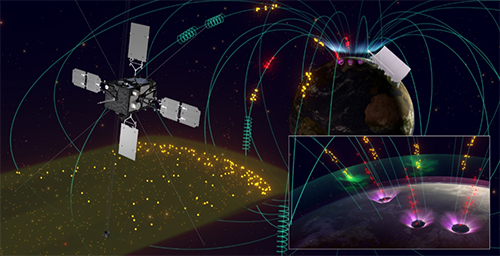
Taken together, these observations suggest the following scenario. First, the strong storm-time convection created a region in the inner magnetosphere where warm ions coexisted with cold electrons, allowing energy transfer from warm ions to cold electrons through Coulomb collisions. As the effects of this heating reached the ionosphere, the ionospheric electrons were heated, potentially creating conditions in which heavy O⁺ ions could more readily flow upward against gravity. Furthermore, the reduction in ionospheric electron content may have made it more difficult for electrons to lose heat to their surroundings, further promoting the increase in electron temperature and O⁺ outflow. Figure 3 schematically illustrates this proposed sequence of processes through which large quantities of O⁺ may have been supplied to the inner magnetosphere.

Figure 3: Schematic illustration of the inferred O⁺ supply process to the inner magnetosphere during the May 2024 geomagnetic superstorm. Strong convection during the storm main phase transports warm ions into the dawnside inner magnetosphere, where they coexist with cold, dense plasma near the outer edge of the plasmasphere. Energy transfer from warm ions to cold electrons through Coulomb collisions may lead to ionospheric electron heating, facilitating heavy-ion upflow along magnetic field lines. This process is thought to have produced an extreme increase in plasma mass and an O⁺-rich plasmasphere in a region close to Earth. (Adapted from Obana et al., 2026.)
In general, during the main phase of a geomagnetic storm, it is difficult for low-energy plasmaspheric plasma and higher-energy plasma transported into the inner magnetosphere by convection to coexist because they follow different paths. During a superstorm, however, exceptionally strong convection moves the outer edge of the plasmasphere deep into the inner magnetosphere, potentially allowing relatively dense low-energy plasma to coexist with higher-energy plasma. How strong must convection be to create a region of coexistence sufficient to produce the ionospheric heating observed in this event? Answering this question requires analysis of many additional events and remains a subject for future research. Other processes, including strong electric fields and wave-particle interactions, may also contribute to ionospheric heating. The present observations alone cannot identify a single heating mechanism, and further verification through detailed observations and numerical simulations is required.
Can Earth's Atmosphere Change the Magnetosphere During a Superstorm?
An important implication of these observations is that, during geomagnetic superstorms, Earth's atmosphere does not merely react passively to the external influence of the solar wind. When energy from an intense solar wind enters the magnetosphere, it drives large-scale plasma convection. As its effects reach the ionosphere, large quantities of O⁺ originating from Earth's atmosphere may then be supplied to the magnetosphere, substantially changing the mass and composition of the magnetospheric plasma itself.
Since its launch in 2016, Arase has continued comprehensive observations of plasma particles, electric and magnetic fields, and plasma waves in the inner magnetosphere. In addition to capturing a rare geomagnetic superstorm, this study combined Arase's in situ observations with ground-based observations from around the world. This approach simultaneously revealed the spatial extent of the enhancement, which cannot be determined by a satellite passing through a single location alone, and the plasma composition, which cannot be determined from ground-based observations alone. Another advantage of this method is that it can assess the average composition of the plasma as a whole, including very low-energy ions originating from the ionosphere that are difficult to detect directly with Arase's particle instruments. Furthermore, incorporating ionospheric observations from DMSP satellites and GNSS made it possible to investigate not only the increase in O⁺ in the inner magnetosphere but also what was happening in the ionosphere, its source region.
Extending similar analyses to other geomagnetic storms and identifying the conditions that enhance the supply of heavy ions from the ionosphere are expected to improve our understanding of how the magnetosphere responds to superstorms. Major changes in plasma composition also influence electromagnetic waves and high-energy particles in the magnetosphere, making this an important issue for understanding and predicting space weather phenomena. The future FACTORS geospace exploration mission plans to use multiple satellites to directly observe and investigate the heating and acceleration of ions flowing from Earth's atmosphere into space. Testing the O⁺ supply process suggested by Arase and the ground-based and ionospheric observations in this study against observations from its source region is expected to further advance our understanding of the circulation of matter between Earth's atmosphere and the magnetosphere during geomagnetic storms. Understanding such atmospheric outflow processes also has implications beyond Earth, helping us understand how planets with magnetic fields have retained and lost their atmospheres over long timescales.
Glossary of Terms
*1 Geomagnetic Storm
A phenomenon in which an intensified solar wind, associated with explosive events on the Sun and other solar activity, strongly disturbs Earth's magnetosphere for several hours to several days. Strong geomagnetic storms can produce low-latitude auroras and affect satellites, communications, and positioning systems.
*2 Oxygen Torus
A region of enhanced O⁺ density in the magnetosphere, with the ions originating from Earth's atmosphere. Such regions have traditionally been known to form mainly near the outer edge of the plasmasphere during the recovery phase of geomagnetic storms.
*3 Plasmasphere
A region relatively close to Earth where cold, dense plasma originating from the ionosphere is trapped by the magnetic field. Its outer boundary is called the "plasmapause," whose location changes substantially during geomagnetic storms.
*4 SYM-H Index
One of the indices used to describe the intensity of geomagnetic storms. It is calculated from geomagnetic observations at low and middle latitudes around the world and primarily reflects the strength of the ring current surrounding Earth. In general, increasingly negative values indicate stronger geomagnetic storms.
*5 Plasma Wave Experiment (PWE)
One of the instruments aboard Arase. It measures electric fields and plasma waves in space over a wide frequency range. In this study, electron number density was derived from upper hybrid resonance waves observed by PWE's High Frequency Analyzer (HFA).
*6 Upper Hybrid Resonance (UHR) Waves
A type of characteristic electromagnetic wave observed in plasma. Because their frequency is closely related to electron number density, they can be used to measure electron density in space from satellites.
*7 Magnetospheric Convection
The large-scale circulation of plasma within the magnetosphere driven by interactions between the solar wind and Earth's magnetosphere. Convection intensifies during geomagnetic storms, transporting plasma from the magnetotail into the inner magnetosphere close to Earth.
*8 Coulomb Collisions
A process through which charged particles exchange energy by exerting electrical forces on one another. This study suggests that this energy transfer from warm ions transported during the storm to cold electrons may have played an important role.
Publication Information
Title: Extreme O⁺ Enrichment in the Deep Inner Magnetosphere: The May 2024 Geomagnetic Storm
Corresponding Author: OBANA Yuki (Research Associate Professor, International Research Center for Space and Planetary Environmental Science (i-SPES), Kyushu University)
Authors: Yuki Obana, Naritoshi Kitamura, Atsuki Shinbori, Kazuhiro Yamamoto, John Malone-Leigh, Craig J. Rodger, Tanja Petersen, Chae-Woo Jun, Tomoaki Hori, Yoshizumi Miyoshi, Yuichi Otsuka, Atsushi Kumamoto, Fuminori Tsuchiya, Yoshiya Kasahara, Mariko Teramoto, Ayako Matsuoka, Yoichi Kazama, Shiang-Yu Wang, Sunny W. Y. Tam, Tzu-Fang Chang, Bo-Jhou Wang, Kazushi Asamura, Iku Shinohara, Shoichiro Yokota, Kunihiro Keika, Satoshi Kasahara, Marc Hairston, Septi Perwitasari, Michi Nishioka
JAXA-affiliated authors: SHINOHARA Iku, ASAMURA Kazushi
Journal: Earth, Planets and Space
DOI: 10.1186/s40623-026-02452-5
Publication date: 23 May 2026