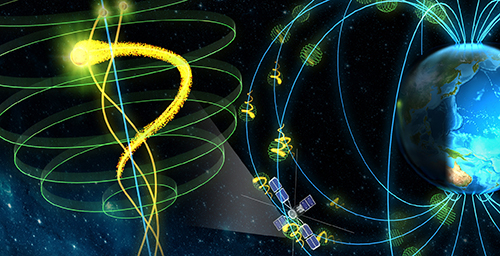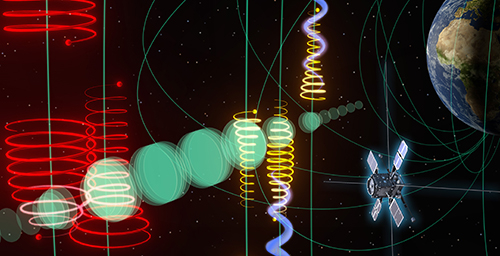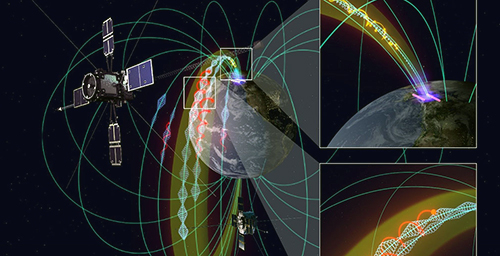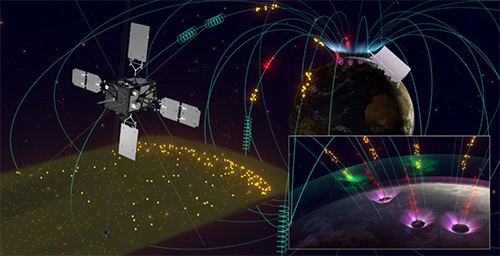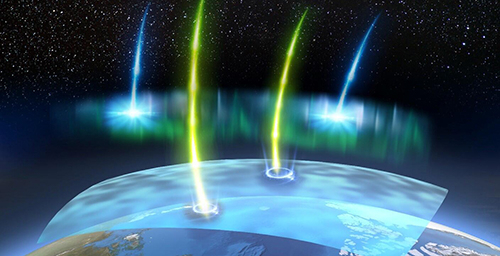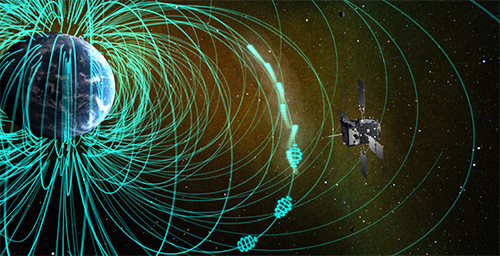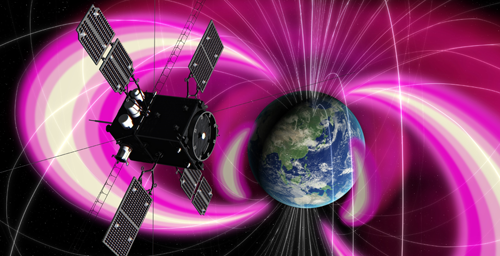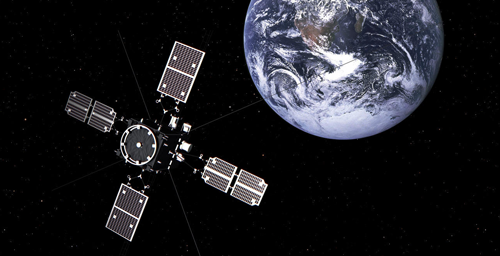


Fig. 1: An image of the Arase satellite observing ring current ions during the geomagnetic storm. (Credit: ERG Science Team)
Overview
The region within the influence of the Earth's intrinsic magnetic field is referred to as the magnetosphere. With advances in satellite-based space utilization, the magnetosphere is becoming increasingly important from a space weather perspective. Within the magnetosphere, the strongest disturbances are geomagnetic storms. Understanding the development of the ring current (Note 1)―particularly its characteristics, such as the composition and energy of the ions that carry the current, as well as their origin―is central to understanding geomagnetic storms. While it was known that these ions during moderate or major storms are a mixture of those originating from the solar wind (Note 2) and those originating from Earth's ionosphere, a lack of observations during super geomagnetic storms had prevented us from clarifying the mixing ratio of these ions during such events and the origin of those ions. A super geomagnetic storm occurred in May 2024 for the first time in 20 years, and the Arase satellite (Note 3) successfully conducted detailed in situ observations of ring-current ions. As the solar wind driving this super storm was dense, it was expected that solar wind-origin ions might contribute to a certain proportion due to their inflow to the magnetosphere. However, the observed ring-current ions (9.6-184.2 keV, kiloelectron volts) were overwhelmingly (>85%) of terrestrial origin―particularly heavy ions― while the contribution of solar wind ions was extremely small. This indicates that, although the energy driving geomagnetic storms originates from the solar wind, the supply of ions from the Earth's ionosphere is overwhelmingly important in replenishing the ring current and plays a crucial role in the development of super geomagnetic storms. Although such events are rare, from a space weather perspective, it is important to understand and predict changes in the space environment during super geomagnetic storms. These observational results provide valuable insights into the physical processes underlying the development of super geomagnetic storms.
Background
High-density, high-speed solar wind, accompanied by a strong magnetic field, is generated by explosions on the Sun's surface, known as solar flares. When it arrives, it can drastically alter the environment in the magnetosphere, potentially triggering a geomagnetic storm (Fig. 1). Super geomagnetic storms can trigger space weather phenomena such as low-latitude auroras visible even from Japan, satellite malfunctions, and reduced positioning signal accuracy; there have even been instances where large-scale power outages occurred. For this reason, understanding super geomagnetic storms is the most critical issue in magnetospheric space weather research, from the perspectives of their impact on daily life and the utilization of space.
The intensity of a geomagnetic storm is usually evaluated based on the decrease in magnetic field intensity at mid- to low-latitude regions, and the current that is the primary cause of these magnetic field variations develops in a region above the Earth (several times the Earth's radius of 6,378 km). This current, called the ring current, is carried mainly by high-energy ions. Understanding the origin of these ions is a challenge in understanding the development of geomagnetic storms. Observations by satellites have revealed that the high-energy ions consist of a mixture of hydrogen ions originating from the solar wind, heavy ions, such as singly charged oxygen ions that originate from the Earth's ionosphere and are not present in the solar wind, and hydrogen ions originating from the ionosphere. Furthermore, it has been reported that during geomagnetic storms, the energy density of singly charged oxygen ions has increased in several instances, becoming the largest contributing component; oxygen ions are increasingly recognized as notable contributors during major geomagnetic storms. However, the energy of the ions in the ring current lies within a range that is technologically difficult to measure,, and the influence of radiation belt particles around the Earth increases noise during observations, making it easy for the real signal to be masked by noise. For this reason, only a few prior satellites were able to distinguish ions by mass (≈ ion species) and observe them with high precision; thus, the observational data were available only during limited periods. Hence, observations of ring-current ions during major storms, which are rare, are scarce, and there have been no events in which solar wind data were observed simultaneously with ring current ions during super geomagnetic storms. Two possibilities have been proposed regarding the ring current associated with super storms driven by high-density solar wind, and observational verification has been awaited.
- Ions of Earth origin and ions of solar wind origin both contribute substantially (a situation similar to that during major geomagnetic storms).
- Ions of Earth origin account for the overwhelming majority, while ions of solar wind origin contribute very little (a situation even more extreme than that during major geomagnetic storms).
Results
The plasma ejected by multiple large solar flares reached the Earth, and a super geomagnetic storm developed from May 10 to 11, 2024. One of the indices of geomagnetic variations in mid-to-low latitudes―the SYM-H index, which represents variations in the horizontal component of the magnetic field at the magnetic equator―reached a minimum value of −518 nT, which is the second-largest magnitude since 1981, when the SYM-H index became available. This was the first storm with a similar magnitude in ~20 years, since the one in November 2004. The Japanese Arase satellite crossed the dusk side ring-current region from the outside to the inside just after the onset of the storm and shortly after its peak time, successfully acquiring in situ observational data on the electromagnetic field and plasma. The satellite's ability to encounter such a rare, super geomagnetic storm event was the result of more than seven years of continuous observations. The Arase satellite is equipped with two ion instruments: the Low-Energy Particle Experiments-Ion Mass Analyzer (LEP-i) and the Medium-Energy Particle Experiments-Ion Mass Analyzer (MEP-i). The MEP-i, in particular, is a newly designed instrument specialized for observing ions in the ring-current energy range, and it has successfully acquired high-quality data on their composition and energy spectra.
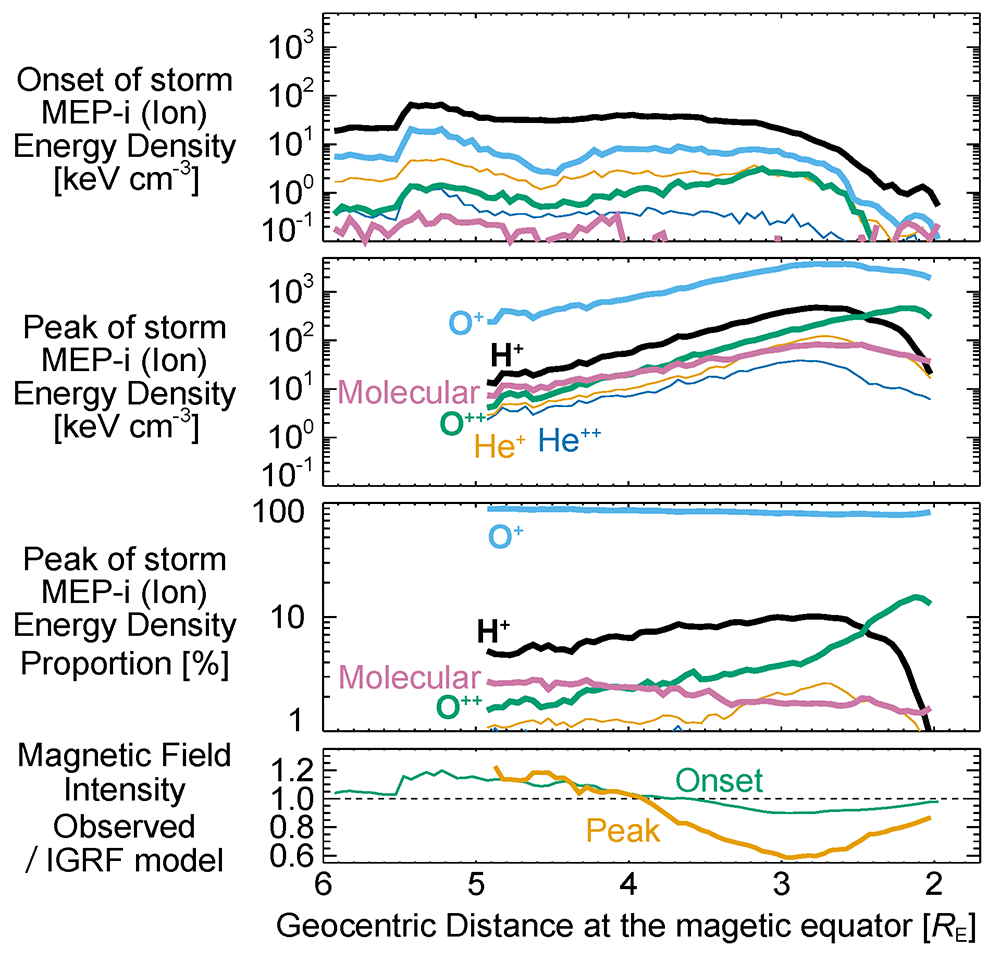
Fig. 2: Radial spatial distribution of ring-current ions and variations in magnetic field intensity on the evening side. (From top to bottom: energy density distribution of high-energy ions just after the onset of the storm; energy density distribution near the peak of the storm; proportion of each ion species in the energy density near the peak of the storm; and the ratio of the observed magnetic field intensity to that of the International Geomagnetic Reference Field (IGRF) model.)
Around the time when the storm was at its peak, singly-charged oxygen ions (O+) in particular increased markedly, peaking at 2.5-3 Earth radii (RE) in geocentric distance (1.5-2 RE in altitude), and accounted for the overwhelming majority. Near the Earth, the proportion of doubly-charged oxygen ions (O++) also increased, and their contribution exceeded that of hydrogen ions (H+). Molecular ions were also observed, while the contribution of helium ions (He+, He++) was negligible.(Modified from Kitamura et al., 2026)
In this geomagnetic storm, during which the SYM-H index fell below −250 nT, we successfully conducted the first simultaneous in situ direct observations of ring-current ions and observations of the solar wind. These simultaneous observations revealed that, despite the high density of the solar wind―a condition under which an influx of ions into the magnetosphere would be expected―Earth-origin ions (particularly heavy ions) constituted the overwhelming majority of the ring current (Fig. 2). This is the first time it had been observed that Earth-origin ions accounted for such an overwhelming proportion across a wide region of the ring current. These observational results are consistent with the idea that, "in the ring current during a super geomagnetic storm, ions of Earth origin account for the overwhelming majority, while ions of solar wind origin contribute very little." Furthermore, these findings indicate that during super storms, the process by which "energy from the solar wind ultimately accelerates (primarily) heavy ions escaping from the Earth's ionosphere to form the ring current" is overwhelmingly important for their development.
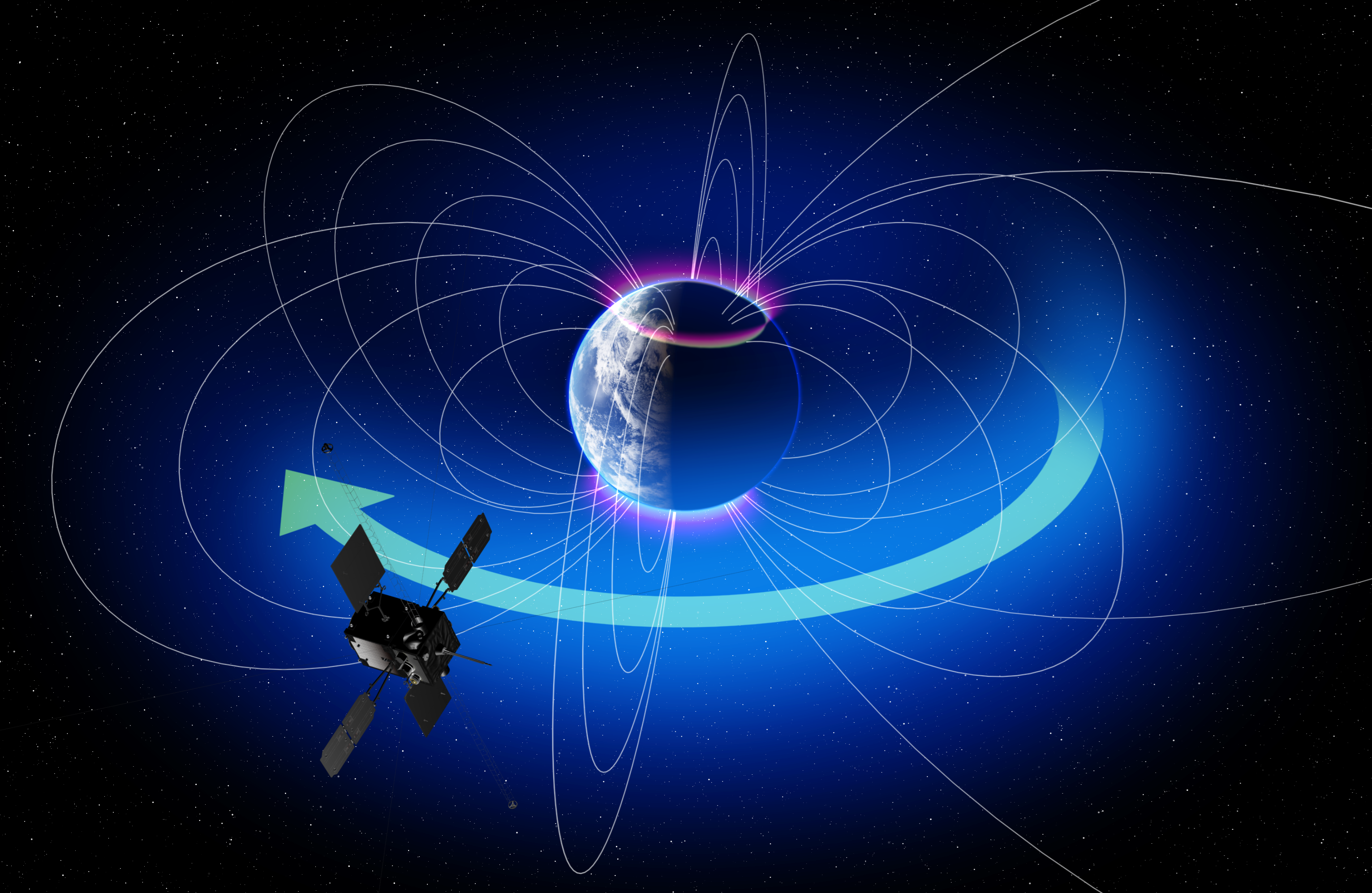
We also demonstrated that the region of highest ion energy density lies at ~2.5-3 Earth radii (RE) in geocentric distance (Figs. 2 and 3). Additionally, near the Earth (~2 RE in geocentric distance), the proportion of Earth-originating doubly-charged oxygen ions also increased, contributing to the energy density to an extent equal to or greater than that of hydrogen ions―a previously unrecognized situation.
Due to the influence of the intense ring current, a remarkable (40%) decrease in the magnetic field intensity was observed around ~3 RE in geocentric distance (Fig. 2). This variation in magnetic field intensity affects not only ion transport but also the transport of ultra-high-energy electrons in the radiation belt; it may contribute to the outflow of radiation-belt electrons from regions close to the Earth into interplanetary space, leading to their disappearance. In fact, the Extremely High-Energy Electron Experiment (XEP) on the Arase satellite has observed a temporary decrease in ultra-high-energy electrons in the radiation belt outside of the region of reduced magnetic field intensity. Further quantitative research is expected to elucidate the significance of variations in the near-Earth magnetic field.
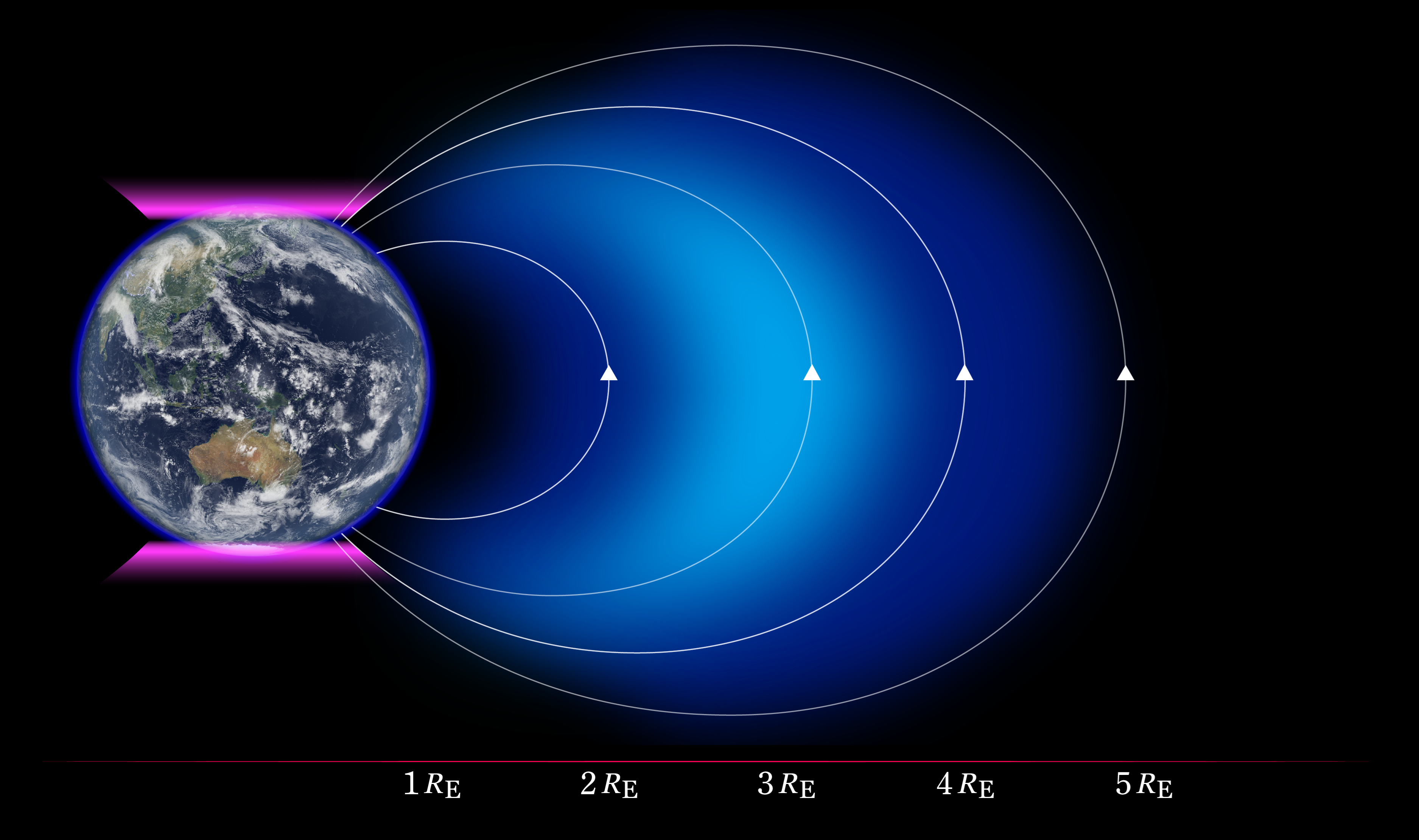
Fig. 3: Schematic image of ring-current ions on the dusk side near the peak of the geomagnetic storm. (Credit: ERG Science Team)
Going Forward
By deepening our physical understanding of the development of super geomagnetic storms from these observations, we expect to improve our ability to predict the evolution of extreme geomagnetic storms―which have yet to be directly observed by satellites and can significantly impact daily life in modern society. Moreover, this study suggests that the development of the intense ring current induced by heavy ions may specifically influence the disappearance of ultra-high-energy electrons of the radiation belt near the Earth. These findings can also contribute to advancing space utilization by a better understanding of the mechanisms underlying variations in radiation-belt electrons during geomagnetic storms.
This study was supported by Grants-in-Aid for Scientific Research of the Japan Society for the Promotion of Science grant 20H01957 and 25H00684.
Terms
Note 1: Ring current
The current develops during geomagnetic storms around the Earth (several times the Earth's radius of 6,378 km). The predominance of westward currents generates a southward magnetic field, which is opposite to the geomagnetic field, near the Earth's surface. Hence, it contributes most significantly to the decrease in geomagnetic field intensity at mid- and low-latitudes. The primary carriers of these currents are high-energy ions (tens of kiloelectronvolts), consisting of a mixture of ions originating from the solar wind and ions originating from the Earth. In the upper region of Earth's atmosphere, also known as the ionosphere, the energy of ions is an order of 0.1 electronvolt; therefore, as they flow out and are transported, they must be accelerated to energies ~100,000 times greater.
Note 2: Solar wind
A stream of charged particles (plasma) originating from the Sun. It consists primarily of hydrogen ions and electrons, but also includes doubly charged helium ions and highly charged (i.e., having lost many electrons) heavy ions. Some of the solar wind ions penetrate the magnetosphere and are considered an important source of ions within the magnetosphere. In particular, it is believed that a large number of ions penetrate the magnetosphere under high solar wind number density conditions.
Note 3: Arase satellite
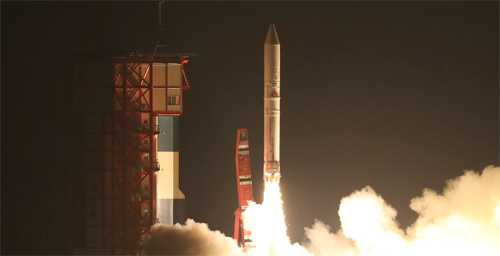
The Arase satellite was launched on December 20, 2016. Its perigee altitude is ~350 km above the Earth, and its apogee altitude is ~32,000 km (~6 Earth radii (RE) in geocentric distance). It orbits in an elliptical orbit with a period of ~9.5 hours, continuously conducting comprehensive observations of the electromagnetic fields and plasma in the low-latitude region of the inner magnetosphere. This elliptical orbit intersects the bulk of ring-current ions during geomagnetic storms, making it well-suited to understanding the radial distribution of ions. The Arase satellite has been operated by the Japan Aerospace Exploration Agency (JAXA). The ERG (Arase) science center is jointly operated by Institute of Space and Astronautical Science (ISAS)/JAXA and Institute for Space-Earth Environmental Research/Nagoya University.
Publication Information
Journal: Science Advances
Title: Extreme dominance of Earth-origin heavy ions in the intense ring current near the Earth during the May 2024 super geomagnetic storm
Authors:
Naritoshi Kitamura1, Kazuhiro Yamamoto1, Shoichiro Yokota2, Satoshi Kasahara3, Ayako Matsuoka4, Kazushi Asamura5, Yusuke Ebihara6, Lynn M. Kistler1,7, Kunihiro Keika3, Atsuki Shinbori1, Tomoaki Hori1, Yoshizumi Miyoshi1,8, Akimasa Ieda1, Chae-Woo Jun1, Mariko Teramoto9, Masahito Nosé10, Masafumi Hirahara1, Kanako Seki3,11, Nana Higashio5, and Iku Shinohara5
Affiliations:
1 Institute for Space-Earth Environmental Research, Nagoya University, Nagoya, Japan.
2 Department of Earth and Space Science, Graduate School of Science, The University of Osaka, Toyonaka, Japan.
3 Department of Earth and Planetary Science, Graduate School of Science, The University of Tokyo, Tokyo, Japan.
4 Data Analysis Center for Geomagnetism and Space Magnetism, Graduate School of Science, Kyoto University, Kyoto, Japan.
5 Institute of Space and Astronautical Science, Japan Aerospace Exploration Agency, Sagamihara, Japan.
6 Research Institute for Sustainable Humanosphere, Kyoto University, Uji, Japan.
7 Institute for the Study of Earth, Oceans, and Space, University of New Hampshire, Durham, New Hampshire, USA.
8 Kyung Hee University, Suwon, Korea.
9 Department of Space Systems Engineering, Kyushu Institute of Technology, Kitakyushu, Japan.
10 Graduate School of Data Science, Nagoya City University, Nagoya, Japan.
11 Research Center for Advanced Science and Technology, The University of Tokyo, Tokyo, Japan.