Arase Reveals an Unexpected Radiation Belt Response to the May 2024 Superstorm
Abstract
Earth's radiation belts contain high-energy electrons that can damage satellites. For more than a decade, observations have suggested that ultra-relativistic electrons, which travel close to the speed of light, rarely enter a region relatively close to Earth, protected by what scientists call the "impenetrable barrier." But can this barrier withstand an exceptionally powerful geospace storm?
Previous satellite observations had revealed unexpected increases in high-energy electrons inside this barrier during extreme geospace storms. However, it remained unclear whether these electrons had been transported inward from more distant regions or accelerated locally.
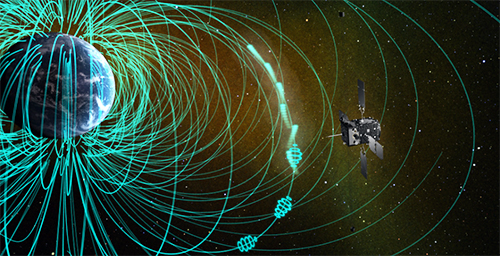
An international research team has now found an answer using observations from JAXA's Arase (ERG) satellite during a superstorm that occurred in May 2024. By combining measurements of energetic electrons, magnetic fields, plasma waves, and plasma density, the team identified a growing local peak in electron phase space density (a measure of how electrons are distributed according to their position and motion) inside the previously identified barrier. This newly formed peak could not be explained simply by electrons moving inward from more distant regions. A growing local peak in this distribution therefore provides strong evidence that electrons were accelerated locally to energies of several million electron volts (MeV), rather than simply transported inward.
The team also detected intense chorus waves―naturally occurring electromagnetic waves capable of accelerating electrons―in the same region. Extreme erosion of the plasmasphere around Earth, together with its delayed recovery likely associated with a negative ionospheric storm (a reduction in ionospheric electron density), created unusual plasma conditions favorable for chorus-driven electron acceleration.
This discovery demonstrates that even regions of near-Earth space previously considered relatively stable can become sources of hazardous high-energy electrons during extreme space weather events. The findings provide important new insights for understanding and predicting radiation hazards in geospace.
1. Background: Why Is There an "Impenetrable Barrier" Around Earth?
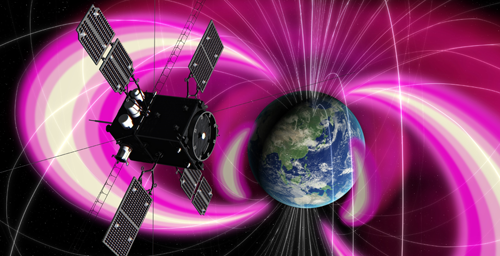
Earth is surrounded by regions of energetic electrons and ions trapped by its magnetic field, known as the Van Allen radiation belts. Some of these electrons reach extremely high energies, exceeding several million electron volts (MeV). Such energetic electrons can damage satellite electronics and pose challenges to space operations.
The outer radiation belt is highly dynamic. Its electron population can increase or decrease dramatically during geospace storms driven by solar activity. In contrast, observations have shown that ultra-relativistic electrons that move at speeds close to the speed of light rarely penetrate into a region closer to Earth, inside approximately L* = 3 (approximately 3 Earth radii or 12,000 km above the Earth's surface). This boundary became known as the "impenetrable barrier" following its identification in 2014.
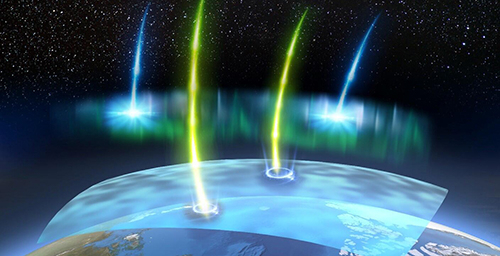
The apparent stability of this region has been attributed to a combination of limited inward electron transport from further out in space and efficient electron loss processes. In particular, the plasmasphere―a region of relatively cold, dense plasma surrounding Earth―supports plasma waves (plasmaspheric hiss) that scatter energetic electrons, causing some of them to enter Earth's atmosphere.
However, during the extreme geospace storms of October-November 2003, known as the Halloween events, low-altitude satellite observations revealed unexpected increases in high-energy electrons deep inside the inner magnetosphere. This raised a fundamental question: Were these electrons transported inward across the barrier, or were they accelerated locally inside it?
Answering this question requires more than simply measuring increases in electron intensity. Scientists need to determine how electron populations change with time and distance from Earth, while also observing the plasma environment and electromagnetic waves that may cause those changes.
Earlier satellite observations lacked sufficiently comprehensive, simultaneous measurements of energetic electrons, plasma density, and plasma waves near the magnetic equator. Consequently, the physical processes responsible for these unusual electron enhancements remained unresolved.
2. Research Approach and Discovery: Arase Reveals Local Electron Acceleration
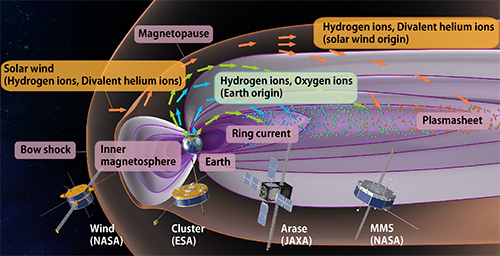
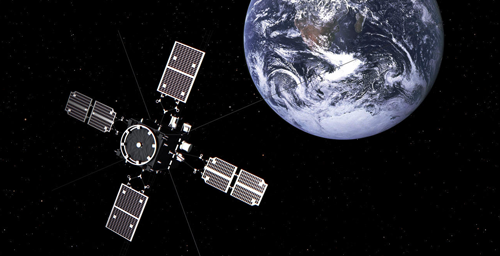
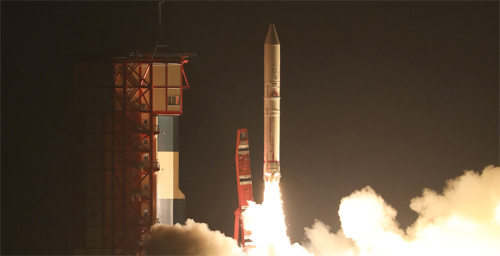
The key to solving this long-standing mystery was JAXA's Arase (ERG) satellite, launched in December 2016 to investigate how energetic particles are accelerated and lost in Earth's magnetosphere.
One of Arase's major strengths is its ability to measure electrons over a wide range of energies while simultaneously observing magnetic fields, plasma waves, and plasma density. Its observations near the magnetic equator are particularly valuable for accurately determining electron phase space density. These capabilities allow researchers to investigate not only how radiation belt electrons change, but also the physical processes responsible for those changes.
The research team focused on the May 2024 superstorm, one of the most intense geospace storms since 2003. The event also attracted widespread attention because auroras were observed at unusually low latitudes, including parts of Japan.
Using measurements from the Extremely High-Energy Electron Experiment (XEP), Magnetic Field Experiment (MGF), and Plasma Wave Experiment (PWE) instruments aboard Arase, the team investigated how energetic electrons and the surrounding plasma environment changed during this extreme event.
First, the team examined long-term Arase observations extending back to 2017. These observations showed that ultra-relativistic electrons generally remained outside the impenetrable barrier during ordinary geospace disturbances. In striking contrast, during the May 2024 superstorm, electrons with energies of approximately 3 MeV increased dramatically inside the barrier.

Figure 1. Long-term evolution of the plasmasphere and radiation belts observed by Arase. During the May 2024 superstorm, approximately 3-MeV electrons appeared and intensified inside the previously identified impenetrable barrier. Adapted from Figure 1 of Miyoshi et al. (2026).
To determine where these electrons originated, the researchers analyzed electron phase space density (PSD), a quantity that describes how electrons are distributed according to their position and motion. Unlike electron flux, which simply measures the number of electrons passing through a given area at a given energy, PSD allows scientists to investigate whether changes in electron populations result from electrons moving from one region to another or from local acceleration. By comparing PSD at different distances from the Earth, the team could distinguish between electrons transported inward from more distant regions and those accelerated locally.
During the early recovery phase of the May 2024 superstorm, a pronounced local peak in PSD developed near L* = 3 and continued to grow. This finding provided compelling evidence for local electron acceleration. If electrons were simply moving inward from more distant regions, such a new local peak would not be expected to form and grow. Instead, the observations strongly indicate that electrons were accelerated locally to multi-MeV energies, creating a new source of ultra-relativistic electrons inside the previously identified impenetrable barrier.
Over the following days, the accelerated electron population gradually spread both inward, toward Earth, and outward, away from Earth.
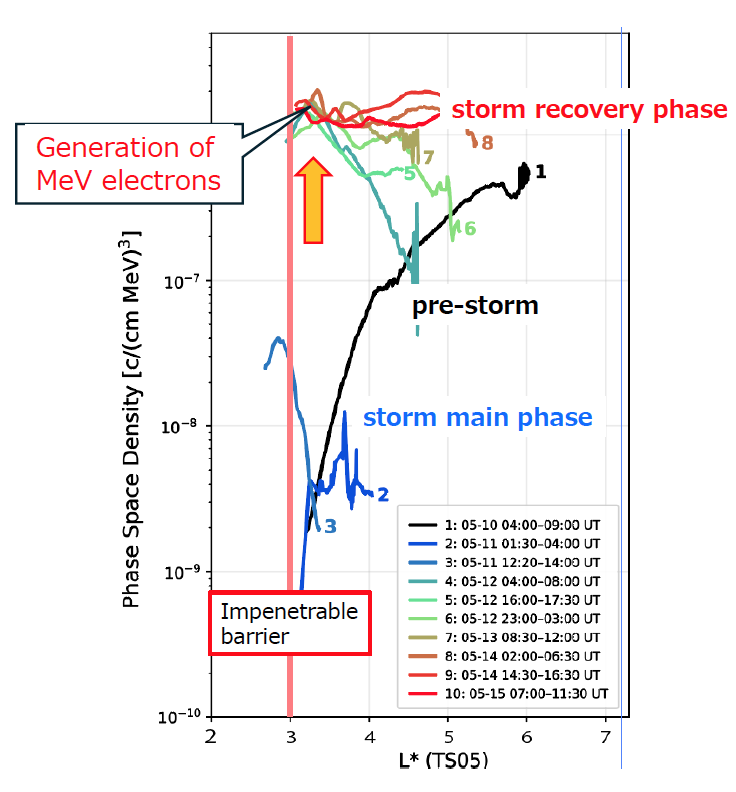
Figure 2. Evolution of electron phase space density during the May 2024 superstorm. A significant local maximum of the phase space density developed near L* = 3 during the early recovery phase, providing strong evidence for local electron acceleration. The accelerated electrons subsequently spread both inward and outward. Adapted from Figure 3 of Miyoshi et al. (2026).
What caused this unexpected electron acceleration?
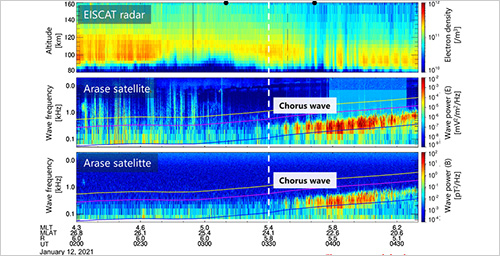
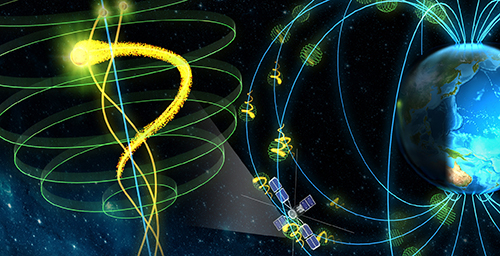
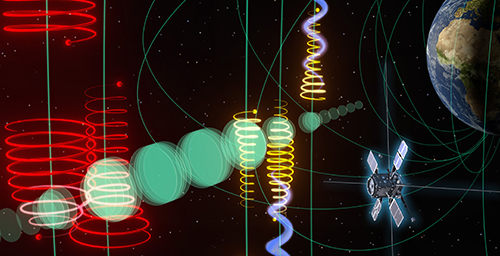
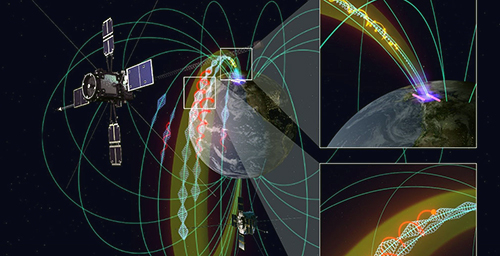
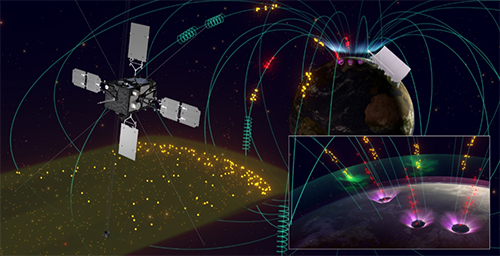
Arase also detected intense whistler-mode chorus waves in approximately the same region where the PSD peak developed. Chorus waves are naturally occurring electromagnetic plasma waves. When converted into audible sound, they resemble birdsong, which is why they are called "chorus." Examples of chorus-wave sounds observed by Arase are available from the ERG Science Center (https://ergsc.isee.nagoya-u.ac.jp/index.shtml.en). Similar to pushing a swing at just the right moment, resonant interactions allow chorus waves to transfer energy to electrons and accelerate them to relativistic energies.
During the May 2024 superstorm, the plasmasphere contracted dramatically due to strong magnetospheric convection. Its outer boundary moved much closer to Earth than usual, reaching approximately L = 1.5. At the same time, a negative ionospheric storm caused a substantial reduction in electron density in Earth's ionosphere. This appears to have contributed to delayed refilling of the plasmasphere, allowing an unusually low-density plasma environment to persist for an extended period.
Under these unusual conditions, intense chorus waves were observed in regions where they are normally weak or absent. The observed wave properties and plasma density were consistent with efficient resonant acceleration of electrons to multi-MeV energies. These findings strongly suggest that chorus waves played an important role in accelerating electrons locally inside the impenetrable barrier.
The ability of Arase to observe energetic electrons, magnetic fields, plasma waves, and plasma density together was crucial to this discovery. These comprehensive measurements allowed the team to connect local electron acceleration with the unusual plasma environment created by the superstorm.
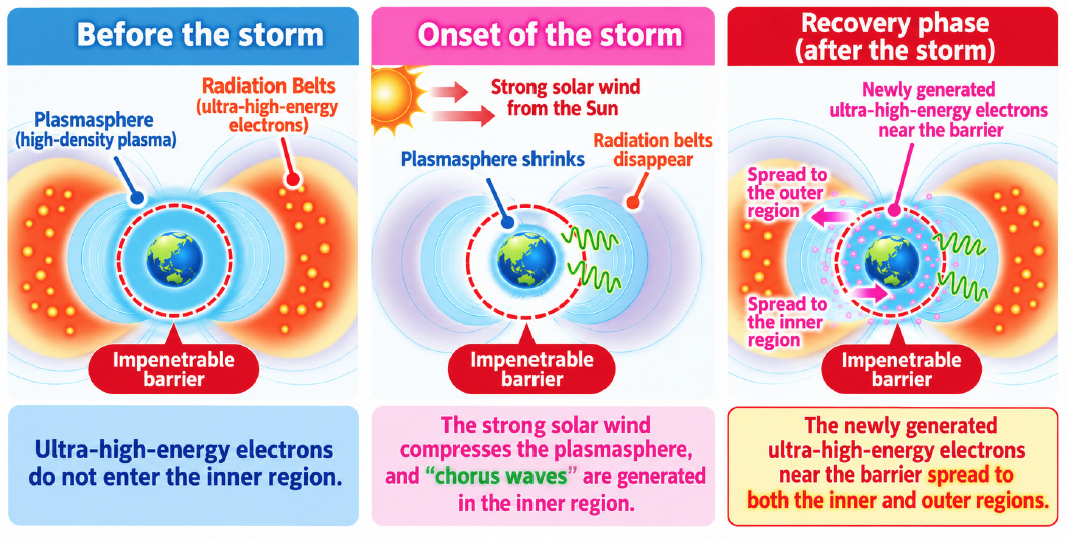
Figure 3. Schematic illustration of the evolution of the plasmasphere, radiation belts, and chorus-wave activity during the May 2024 superstorm. Extreme erosion of the plasmasphere and delayed refilling caused by the negative ionospheric storm created favorable conditions for chorus-driven electron acceleration inside the impenetrable barrier.
3. Scientific Significance and Future Perspectives: Understanding the Unexpected Consequences of Extreme Space Weather
This study provides strong observational evidence that ultra-relativistic electrons can be accelerated locally even inside Earth's previously identified impenetrable barrier during an extreme geospace storm.
The discovery challenges the conventional view that this region is relatively stable and reveals an unexpected mechanism for producing high-energy electrons close to Earth.
An important implication is that radiation belt dynamics cannot be understood by considering energetic particles in the radiation belts alone. Changes in the ionosphere and plasmasphere can create unusual conditions for plasma waves, which may then accelerate electrons in regions where such acceleration is normally limited. This highlights the importance of coupling between different regions of Earth's space environment, from the ionosphere to the magnetosphere, and across different energy ranges.
The discovery also has important implications for space exploration and satellite operations. Under extreme space weather conditions, high-energy electron populations may increase significantly even in regions where such enhancements were previously considered unlikely. Understanding and predicting these events will help improve assessments of radiation hazards, inform satellite protection strategies, and support future human space exploration.
Future research will combine Arase observations with physics-based numerical simulations to investigate the conditions under which local electron acceleration can occur inside the barrier. Particular attention will be paid to how far the accelerated electrons spread, how long they remain near Earth, and how acceleration, transport, and loss processes interact during extreme geospace storms.
The study also highlights the importance of coupling between Earth's magnetosphere and ionosphere in controlling the radiation environment in geospace. Understanding this coupling is an important scientific objective of FACTORS, a proposed mission to investigate the ionosphere-magnetosphere coupling region, which is planned for submission to the next ISAS mission proposal opportunity.
Finally, this discovery demonstrates the unique scientific capabilities of the Arase mission and the value of sustained, comprehensive spacecraft observations. Long-term data processing, archiving, and public distribution by the ERG Science Center (https://ergsc.isee.nagoya-u.ac.jp/index.shtml.en), jointly operated by ISAS/JAXA and the Institute for Space-Earth Environmental Research (ISEE) at Nagoya University, have provided an essential foundation for this research.
The Arase mission continues to demonstrate how comprehensive measurements of particles, fields, and waves can reveal unexpected physical processes in near-Earth space, particularly during rare and extreme space weather events.
Glossary
*1 Van Allen Radiation Belts
Regions surrounding Earth in which energetic electrons and ions are trapped by the geomagnetic field. Highly energetic electrons can cause radiation damage and operational problems for spacecraft.
*2 Impenetrable Barrier
A boundary near L* = 3 (approximately 3 Earth radii or 12,000 km above the Earth's surface) inside which ultra-relativistic electrons have generally been found to be absent or strongly suppressed. Its existence was reported in 2014 based on satellite observations.
*3 Plasmasphere
A region of low-energy, dense plasma surrounding Earth. Its outer boundary contracts dramatically during geospace storms and gradually recovers afterward.
*4 Phase Space Density (PSD)
A physical quantity describing the distribution of particles in the phase space.
By comparing PSD at different distances from Earth while keeping certain properties of electron motion (called adiabatic invariants) fixed, scientists can determine whether electrons were accelerated locally or simply moved inward from more distant regions.
*5 Chorus Waves
Naturally occurring electromagnetic plasma waves (whistler mode) in Earth's magnetosphere. Their frequency variations can resemble birdsong (chorus) when converted into audible sound. Resonant interactions with electrons can produce both acceleration and pitch-angle scattering.
*6 Negative Ionospheric Storm
A storm-time reduction in ionospheric electron density. Such disturbances can influence the replenishment of cold plasma in the magnetosphere and delay plasmasphere refilling.
Publication Information
Title: Local Acceleration of Multi-MeV Electrons Inside Earth's Impenetrable Barrier During the May 2024 Superstorm
Authors: Y. Miyoshi, S. Kurita, A. Shinbori, K. Yamamoto, C.-W. Jun, S. Matsuda, S. Saito, R. Kataoka, D. Wang, I. Shinohara, T. Takashima, T. Mitani, N. Higashio, A. Matsuoka, Y. Kasahara, F. Tsuchiya, A. Kumamoto, T. Hori, N. Kitamura, and M. Teramoto
JAXA-affiliated authors: SHINOHARA Iku, TAKASHIMA Takeshi, MITANI Takefumi, HIGASHIO Nana
Journal: Geophysical Research Letters, 53, e2026GL125879 (2026)
DOI: 10.1029/2026GL125879
Publish date: October 26, 2026.