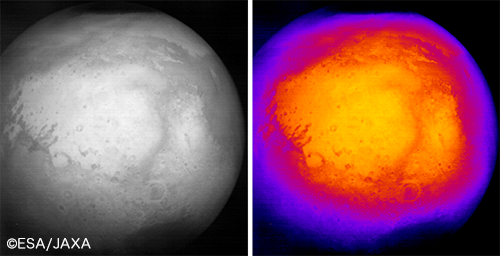
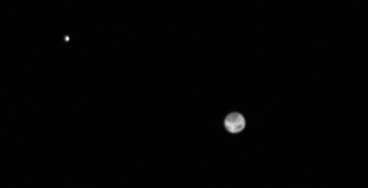
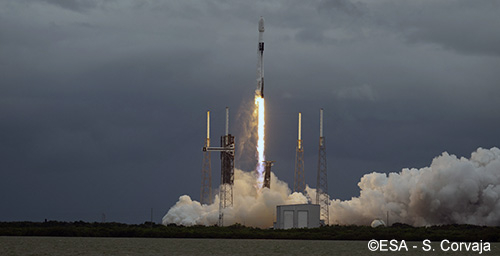
The JAXA Thermal Infrared Imager (TIRI) onboard the Hera spacecraft has captured the first infrared images of the mission's destination, the binary asteroid Didymos and Dimorphos. The asteroid system was impacted by the NASA DART mission in 2022 as an asteroid deflection demonstration for planetary defense. As the DART mission necessitated the spacecraft being destroyed in the impact, Hera will conduct a detailed evaluation of the result of the deflection.
Led by the European Space Agency (ESA), the Hera mission was launch aboard the SpaceX Falcon 9 on 7 October 2024 JST [1]. The spacecraft carries the Thermal Infrared Imager developed by the Japan Aerospace Exploration Agency (JAXA), whose design builds on the TIR imager onboard Japan's Hayabusa2 asteroid explorer.
Following launch, Hera conducted observations of the Earth-Moon system [2], and performed a Mars flyby in March 2025 during which TIRI captured images of Mars and the Martian moon, Deimos [3] while travelling towards the binary asteroid system. Beginning in October 2026, Hera executed a series of braking manoeuvres and arrived at the binary asteroid system at the beginning of November [4]. Details of Hera's upcoming observation and mission operations plan can be found on the Hera website.
The first infrared images from TIRI of asteroid Didymos and its moon, Dimorphos, at a distance of 57 km from the binary system are shown in Figure 1, acquired on 31 October 2026 at 20:19:52 JST. Because TIRI observes thermal infrared radiation in the wavelength range of 8 ~ 14 μm, the brightness (digital number, DN) of each pixel varies according to the surface temperature of the observed body. Using conversion equations derived from ground calibration tests, these DN values can be converted into temperature measurements.
At the time of observation, the binary asteroid system was located approximately 1.2 au from the Sun (1 au, or astronomical unit, is the average distance between the Earth and the Sun, about 150 million km). Analysis of the surface temperature of Didymos is currently ongoing.


Figure 1: Asteroid Didymos and its moon Dimorphos imaged by TIRI at 20:19:52 JST on October 31, 2026. Top: DN (Digital Number) value image. Bottom: Temperature-converted image derived from the DN values. © ESA/JAXA
The temporal variation of these temperatures can be used to estimate the thermal inertia of the asteroid surfaces, a measure of how easily a material heats up and cools down. Thermal inertia, in turn, provides insights into the physical properties of the surface, including whether it is dominated by fine-grained regolith or large boulders, as well as its porosity. Although the surface of the smaller Dimorphos appears relatively cooler than that of Didymos in Figure 1, this is because part of the moon is sitting within the shadow cast by Didymos.
For a comparison to the thermal images, Figure 2 shows the binary asteroid system imaged by the visible-light Asteroid Framing Camera (AFC) onboard Hera from a distance of 60 km, in nearly the same observation geometry (the relative positions of the spacecraft, the Sun, asteroid Didymos, and its moon Dimorphos) as the TIRI observation [5]. At the time of the observation, the solar phase angle (the angle between the Sun, the asteroid, and the spacecraft) was approximately 45°, indicating that only the sunlit side of the asteroid surfaces was visible. You can just see the moon Dimorphos appearing as a thin crescent.
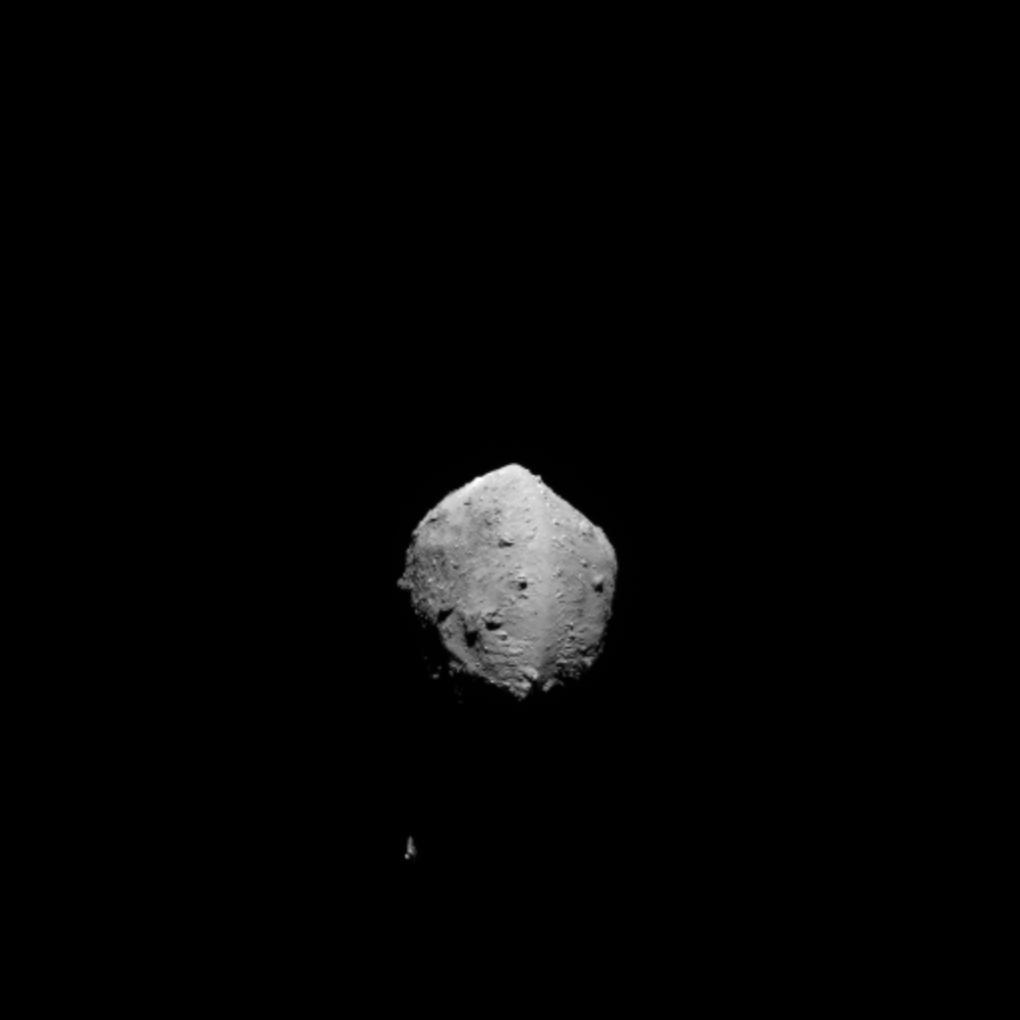
Figure 2: The binary asteroid system imaged by the Asteroid Framing Camera (AFC) from a distance of 60 km. © ESA [Original image from ESA]
Unlike visible-light observations, the thermal TIRI is capable of observing the surfaces of the asteroids on their night-time sides, where direct sunlight does not reach. Because thermal infrared observations detect heat emitted from the surface itself rather than reflected sunlight, TIRI can reveal thermal characteristics even in regions that appear dark in visible-light images. This capability provides important information about the thermal properties and physical state of the asteroid surfaces as they cool during the night hours that cannot be obtained from visible observations alone.
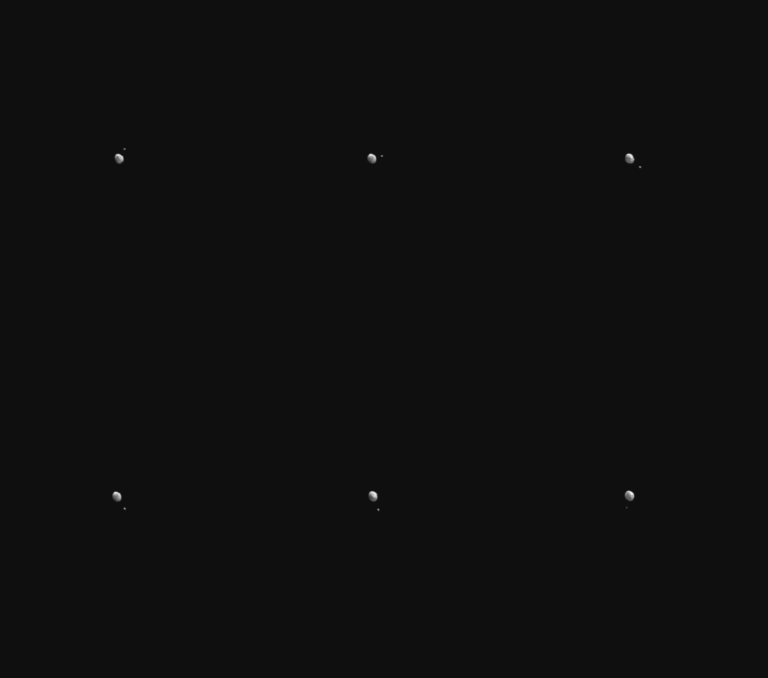
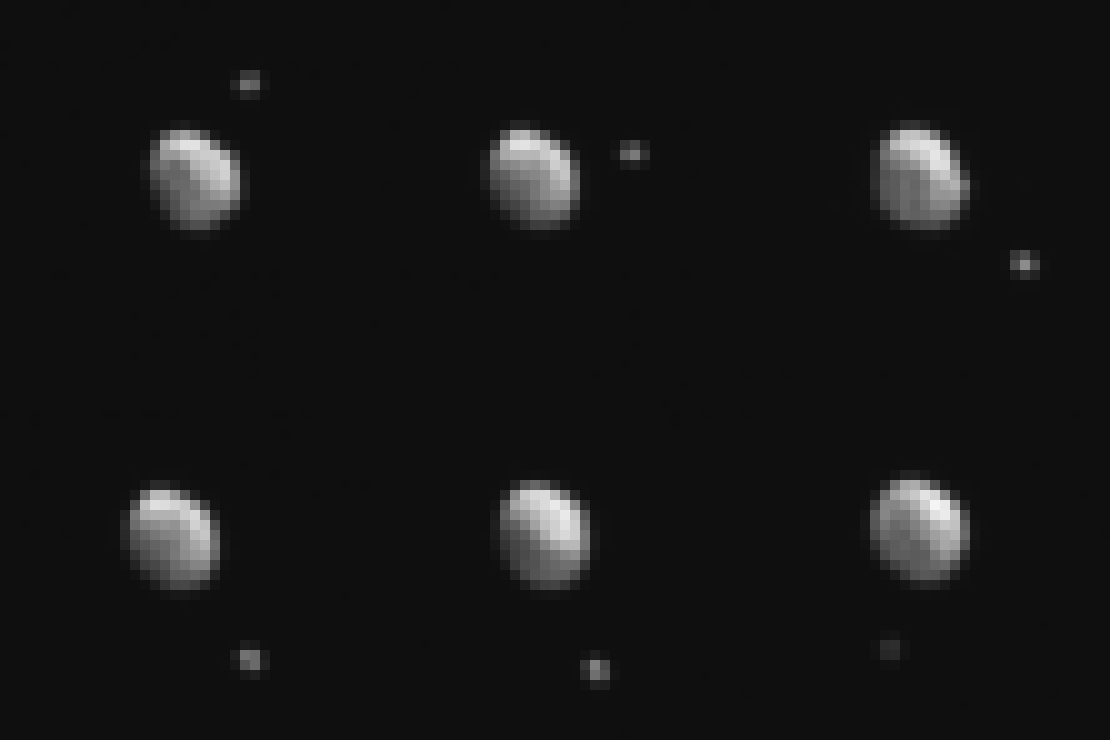
Figure 3: Motion of the binary asteroid system as observed by TIRI between 19:20:27 on October 28 and 00:29:01 on October 29, 2026 (JST). Top: Full-field TIRI images. Bottom: Cropped view of the images shown on the left. A 3 × 3 binning process was applied to emphasize the decrease in brightness values as Dimorphos enters the shadow cast by Didymos. © ESA/JAXA
Figure 3 shows the motion of the binary asteroid system as observed by TIRI. At the time of these observations, the solar phase angle was approximately 45°, meaning that the asteroids appeared half-illuminated in visible-light images, similar to a half moon. In contrast, because TIRI detects thermal infrared radiation and can observe the asteroid surfaces even in shadow, the thermal images make it possible to determine the asteroid pair's global shapes.
In the video, the temperature (image brightness) of Dimorphos can be seen to decrease as it passes into the shadow cast by Didymos. This phenomenon cannot be directly observed with visible-light cameras. The successful detection of this temperature variation represents an important observation for estimating the physical properties of Dimorphos, including its thermal characteristics and surface material properties.
Comment from Okada Tatsuaki
Hera Japan Project Team Leader
Associate Professor, Department of Solar System Sciences, ISAS JAXA
Following the thermal imaging observations of asteroids Ryugu and Torifune with the TIR (Thermal Infrared Imager) aboard Hayabusa2, I am delighted that asteroid observations are finally beginning with TIRI, the thermal infrared camera that we have been developing for the Hera mission since 2020. I would also like to express my sincere gratitude to everyone who contributed their support and cooperation throughout its development.
We will continue to advance the world's first rendezvous exploration of a binary asteroid system through the combined use of TIRI and Hera's other scientific instruments. Hera is a unique mission that contributes to both planetary defense and planetary science, and we look forward to sharing many exciting scientific achievements in the years ahead.
Comment from Sakatani Naoya
Hera JAPAN Project Team Member
Project Research Assistant Professor, Department of Solar System Sciences, ISAS JAXA
From this point onward, Hera will approach to within 20 ~ 30 km of Didymos and begin detailed scientific observations. Beyond investigating the scientific aspects of the DART spacecraft impact on Dimorphos and its effects on Didymos, the mission marks the beginning of humanity's first true challenge in planetary defense. It is exciting to think about what kind of future this endeavor may help create. I am truly looking forward to the discoveries and achievements that lie ahead.
Comment from Mitsumasu Yuya
Hayabusa2 Extended Mission Team Leader, ISAS JAXA
Congratulations on arrival at the asteroid system! Seeing Dimorphos orbiting its primary body, Didymos, is truly inspiring and fills me with excitement.
Just imagining the mission operations ahead is thrilling: approaching close to Dimorphos for detailed observations, accompanying the asteroid moon on its orbit while observing Didymos, or perhaps even venturing inside Dimorphos's orbit to observe Didymos from entirely new perspectives. These operations sound both challenging and fascinating, and I cannot help feeling a little envious of the opportunities that lie ahead for the Hera team.
I hope you thoroughly enjoy the mission in the months to come. I am also looking forward to the many discoveries and insights that Hera will bring, not only to the field of planetary science but also to the advancement of planetary defense. The mission has enormous potential to deepen our understanding in both areas, and I eagerly await its future achievements.
References
[1] https://www.isas.jaxa.jp/en/topics/003854.html
[2] https://www.isas.jaxa.jp/en/topics/003870.html
[3] https://www.isas.jaxa.jp/en/topics/003968.html
[4] https://www.esa.int/articles/about-us/directorates/operations/space-safety/hera/hera-s-first-close-up-view-of-didymos-asteroids
[5] https://www.esa.int/articles/about-us/directorates/operations/space-safety/hera/hera-s-first-close-up-view-of-didymos-asteroids