



[ 日本語 ]
Traveling to London with a Ryugu grain
At the end of March, on a spring evening in Tokyo as the cherry blossoms were about to bloom, I found myself at Haneda Airport's international terminal. Inside my backpack was a grain from asteroid Ryugu.
In 2020, JAXA's Hayabusa2 mission returned to Earth with samples collected from asteroid Ryugu. These materials are now being studied by scientists around the world to learn about the origin of our planet. A small portion, however, has another role: to be placed on display, giving people the chance to see what the mission brought back and to catch a glimpse of the earliest stages of our Solar System.
I have been involved in exhibiting returned samples at various museums and institutions in Japan, but this time was different. It was an exhibition at an overseas science museum, and I was also serving as a "courier", responsible for transporting the sample.
More than anxiety, I felt a strong sense of anticipation for the new experience ahead.
Professionals behind the exhibition
Upon arrival at Heathrow Airport, I was met at the aircraft door by professional art handlers holding a sign with my name. As the Ryugu sample is a highly unusual artifact, they were there to assist with the necessary paperwork required to guide both me and the sample through customs and officially into the UK. With their support, I cleared customs and headed directly to the Science Museum together with the Ryugu sample.

(Left) Professional art handlers waiting at the arrival gate. (Right) The Ryugu sample transport case used for this mission.
Despite the early morning arrival, museum staff were already there to welcome us. One of the most enjoyable aspects of exhibition work is being able to enter the quiet gallery before opening hours and access the backstage areas. That morning, I walked through the dimly lit gallery, passing rows of exhibits waiting to be explored once the visitors arrive, and handed over the sample in the back-of-house area.
Together with a member of the exhibition team, we examined the condition of the sample under a microscope. The sample to be displayed had been prepared by myself about a month earlier, with one of the Ryugu grains from the asteroid sample returned by the Hayabusa2 mission sealed in transparent epoxy resin and the resin surface polished to make the grain easier to see. Using this type of exhibit sample helps protect the grain from damage during transport and display, while keeping it fixed in place for easier observation. While explaining details such as air bubbles in the resin and the condition of the surface, the exhibition team and myself confirmed its state together. The professionalism of the museum team left a strong impression on me.
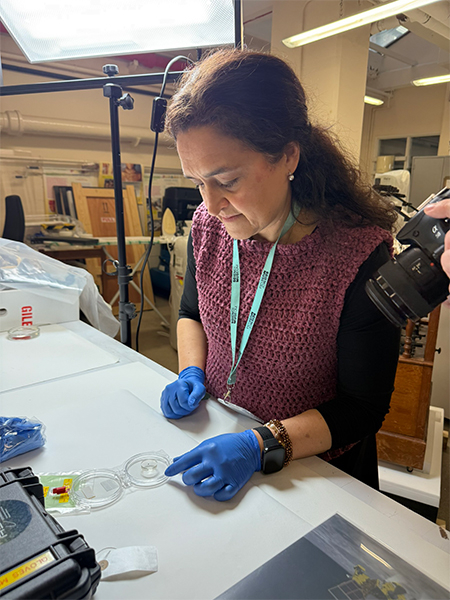
Examining the condition of the sample under a microscope together with a member of the exhibition team.
Installation and final adjustments
The following day, the installation took place in the Science Museum gallery before opening hours. Working together with exhibition designers and technicians, we carefully adjusted the orientation and position of the sample, as well as the height and materials of the display stand, to ensure that the asteroid grain could be seen as clearly as possible.
The exhibit also incorporated carefully designed lighting and a sliding magnifying lens, allowing visitors to first observe the grain with the naked eye and then examine its surface in detail through magnification.
Just a few minutes before opening, once everything was ready, we checked with each other:
"Happy?"
Although not a phrase we commonly use in Japanese, it felt like a gentle way of asking, "Is this good?" Saying "Happy" to one another as a final confirmation created a warm and reassuring atmosphere.
The display was then covered, and the gallery entered a quiet moment before the opening ceremony.
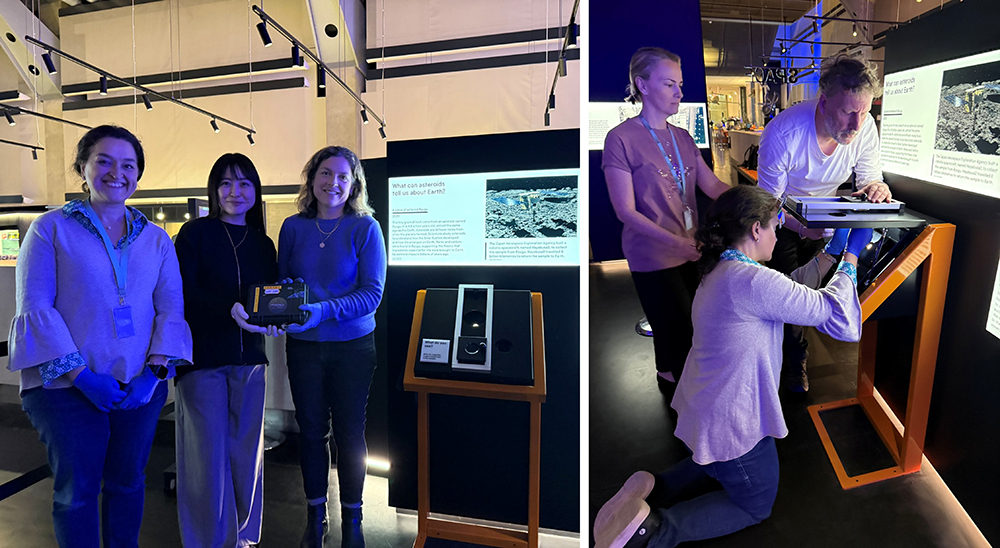
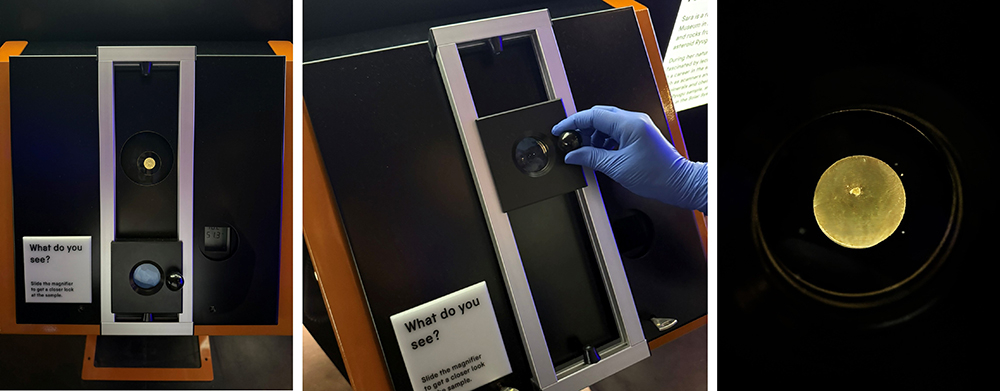
(Top left) Handover of the sample to the Science Museum curator; (Top right) On-site installation by the exhibition team; (Bottom left, center) A display with a sliding magnifying lens, allowing both naked-eye and magnified observation; (Bottom right) Carefully designed lighting highlights the surface texture of the grain.
The exhibition begins
On Monday, the opening ceremony was held.
The ceremony brought together a range of participants, including Sir Ian Blatchford, Director of the Science Museum, the JAXA ISAS Director General Fujimoto Masaki, representatives from the Japanese Embassy, and researchers in the UK who have worked on Ryugu samples. A model of the Martian Moons eXploration (MMX) spacecraft, JAXA's next sample return mission, was presented to Sir Ian Blatchford, and the ceremony proceeded in a relaxed and welcoming atmosphere.
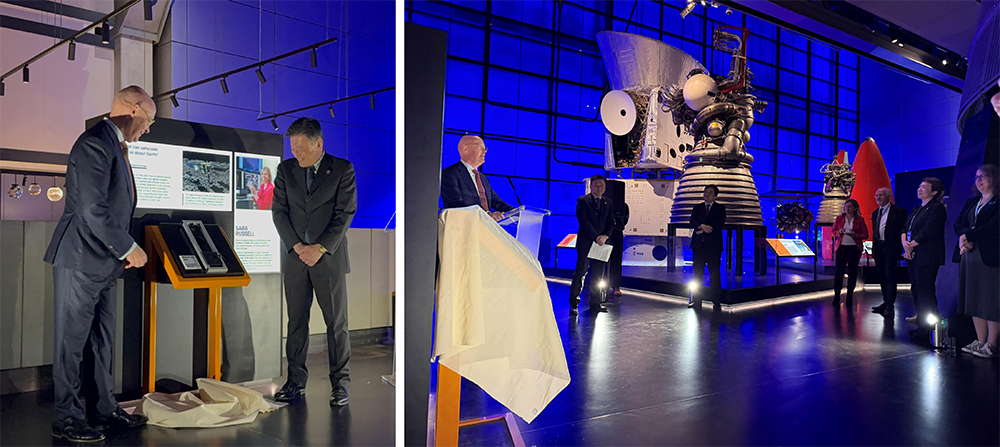
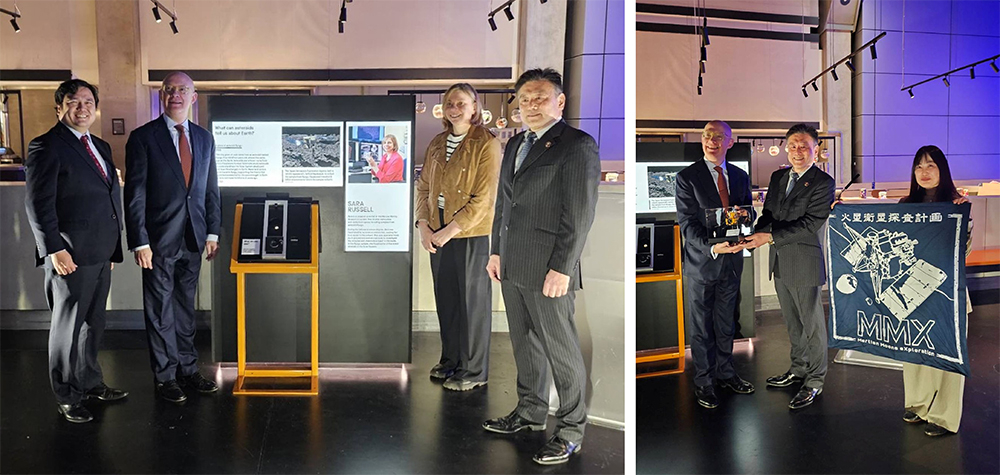
Opening ceremony of the Ryugu grain exhibition. (Bottom left) From left: Takahashi Isao, First Secretary, Embassy of Japan in the UK; Sir Ian Blatchford, Director, Science Museum; Dr. Sara Russell, Merit Researcher, Natural History Museum, London; Dr. Fujimoto Masaki, Director General, JAXA ISAS.
After the ceremony, the exhibition opened to the public. Even on a weekday, many school groups visited, and people quickly gathered around the sample. Looking through the lens, children could be heard saying, "It's a space rock," or "It came from an asteroid." Their eagerness―sometimes even competing for a closer look―was a familiar sight everywhere in the world, and it was impossible not to smile. When I occasionally spoke to them and offered explanations, they listened with a mix of curiosity and shyness. As they looked at the grain, their eyes seemed to be gazing beyond it, toward space itself.
Nearby was an Apollo lunar sample, and behind them, spacecraft displays. Standing in that space, looking at the Ryugu sample, I felt as if the entire gallery was connected to the Universe.
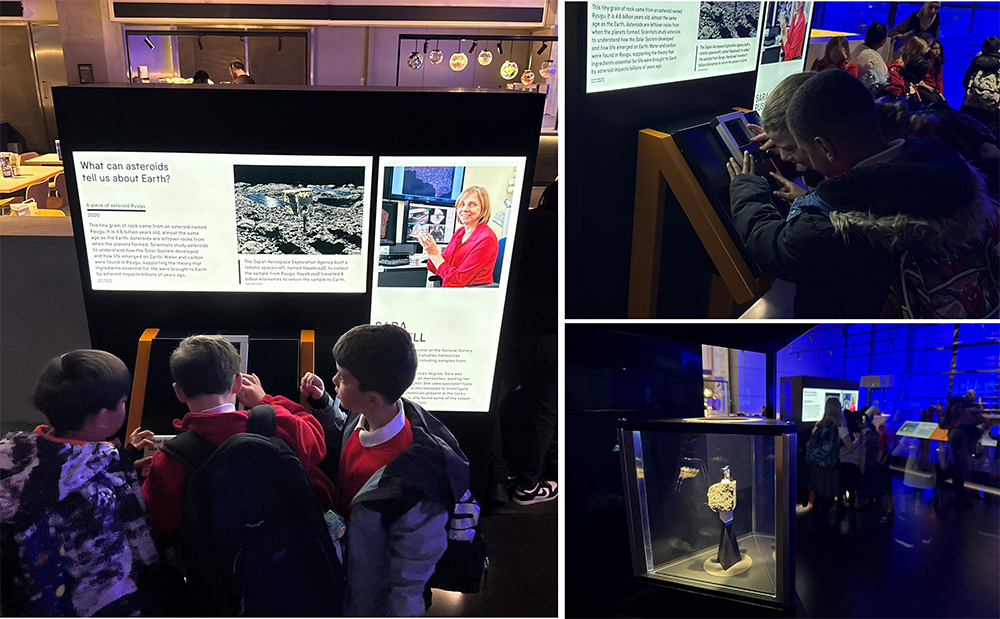
(Left, top right) Children observing the Ryugu grain, (Bottom right) Apollo lunar sample displayed near the Ryugu sample.
A dialogue across missions
On the first day of the exhibition, a talk session was held featuring Professor Giovanna Tinetti, Vice Dean (Research) at King's College London and Principal Investigator of ESA's exoplanet mission ARIEL, and Dr. Fujimoto, Director General of JAXA ISAS. The discussion moved from Ryugu samples to observations of exoplanet atmospheres, connecting different approaches to the question: Where do we come from?
It was striking to see how a tiny grain and distant planets could be linked within a single narrative. The perspective expanded in a powerful way.
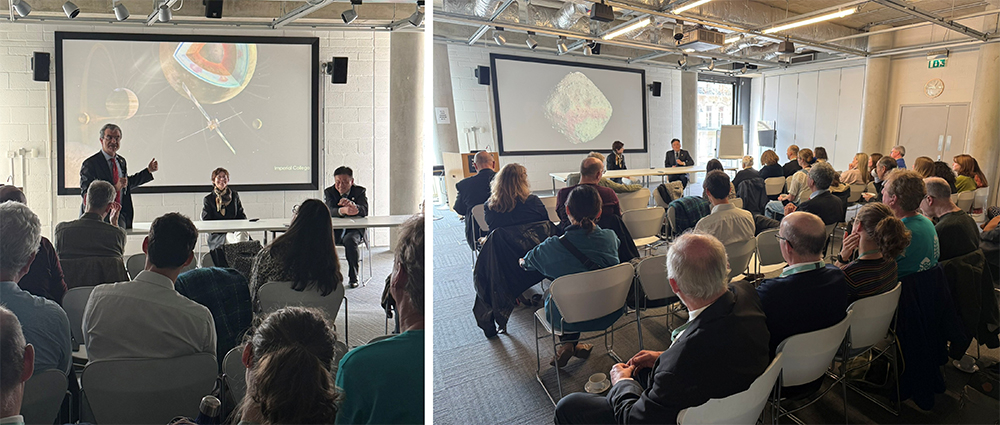
A report on this event was also published on the Science Museum blog: From an Asteroid Grain to Earth and a Thousand Distant Skies
Exhibitions built through connections
This exhibition was not only the result of on-site work but also of long-standing collaborations between ISAS and international partners. Through working with an international team, I gained perspectives that differ from my usual work within Japan. Future sample return missions will involve even more countries and institutions. This exhibition is part of that broader trend, and it made me realize the expanding significance of sample exhibitions.
Looking back, what left the strongest impression on me was the opportunity to work with so many people. Collaborating with international exhibition professionals―from the preparation stage to on-site work―was both refreshing and highly instructive. Each step along the way felt connected. Together, they led naturally to the exhibition that we see today.
The same can be said for the exhibitions I have worked on in the past, and those I will be involved in in the future. Through this experience, I came to feel that exhibitions and outreach activities are something that emerge and grow through connections between people.
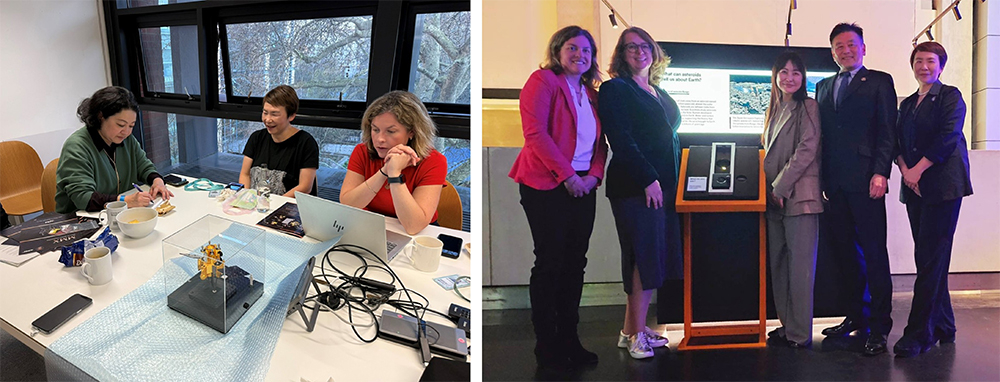
(Left) During preparations for the opening ceremony, (Right) With museum curators in front of the public display.
Work that leads to the next step
Through this visit, I was able to exchange ideas with museum professionals overseas and share perspectives on future exhibitions and outreach activities. In addition to the networks built so far, new connections were formed―an invaluable outcome. At the center of these efforts are the Ryugu samples, the Itokawa samples, and, in the future, the Phobos samples from the MMX mission.
Another role as a courier
Before leaving London, I took on another role as a "courier." At the Natural History Museum, the special exhibition "Space: the Search for Life" (May 2025 - February 2026) has also featured a Ryugu asteroid grain sample. During this visit, I was also responsible for retrieving the sample and models of the MINERVA-II1 rovers, small hopping rovers carried by the Hayabusa2 spacecraft to asteroid Ryugu, which had been displayed alongside the asteroid grain, and bringing them back to Japan.
Standing in front of the sample after the exhibition, I found myself reflecting on the long time this asteroid grain had spent away from the JAXA curation facility in Sagamihara.
From asteroid Ryugu to Earth, through recovery in the Australian desert, to curation in Japan, and finally to its role in London, where visitors from around the world had the chance to see this tiny grain from space.
I also found myself thinking about the many people involved along the way, as well as the countless visitors who had encountered the sample. All of these connections came together, leaving me with a quiet sense of reflection.


Exhibition at the Natural History Museum. (Top) Exterior views of the Natural History Museum. (Middle) Displays from the "Space: the Search for Life" exhibition, including the Ryugu sample and models of MINERVA-II1, the small rovers carried by the Hayabusa2 spacecraft. (Bottom, from left) Dr. Sara Russell, a researcher at the Natural History Museum who studies the Ryugu samples; an NHM researcher working on Ryugu samples.

(Left) Curator at the Natural History Museum who carefully managed the sample and model, (Right) Two art handlers who escorted me and the sample to the departure gate.
Looking ahead
Through this journey, I met many people and encountered their thoughts and feelings toward the sample and the Hayabusa2 mission.
The desire to share these stories remains the same, regardless of place. Connecting people in this way is also an important part of this work.
As I headed home, I found myself thinking about the people I will meet in the future and the exhibitions yet to be created. I also wondered how many people, especially children, we can inspire with an interest in space.
Related Articles on International Exhibitions of Ryugu Grains
- Grains from asteroid Ryugu to be displayed at Cité de l'espace in Toulouse! (June 28, 2023)
- How to carry an asteroid around the world (October 23, 2023)
- Main exhibit spaces for the asteroid Ryugu grains open in Toulouse (France) and London (UK) (November 10, 2023)
- Weekly ISAS Diary: The Southern Sky ― The Pulse of Space Science in Thailand (August 28, 2025)
- The return home! A Ryugu asteroid sample is back in Australia (November 5, 2025, Australia)
- The "homecoming" of asteroid Ryugu to Adelaide, and a Hayabusa2 x Ryugu talk leading to the next adventure (November 12, 2025)
Ojima Tomoko
Associate Senior Researcher, Astromaterials Science Research Group
(2026/05/20)