




TOP > Report & Column > The Forefront of Space Science > 2015 > New Concepts of the Atmospheric-entry Vehicles

 |
||||||

Towards the Era When It Becomes Ordinary to Come and Go Between Space and the Earth In the future, when it becomes ordinary to come and go between space and the earth, what will the vehicles we take look like when we come back to the earth from the space? Case 1: Will it be in a capsule shape just like the Apollo spacecraft and the asteroid explorer “Hayabusa 2�E Or case 2: like a plane with wings as the space shuttle? No, it may be case 3: A strange vehicle covered by thin, soft and giant film with inner tube. Currently, towards the new era, we are conducting researches on the new atmospheric-entry vehicles with completely new features in case 3. (Figure 1) 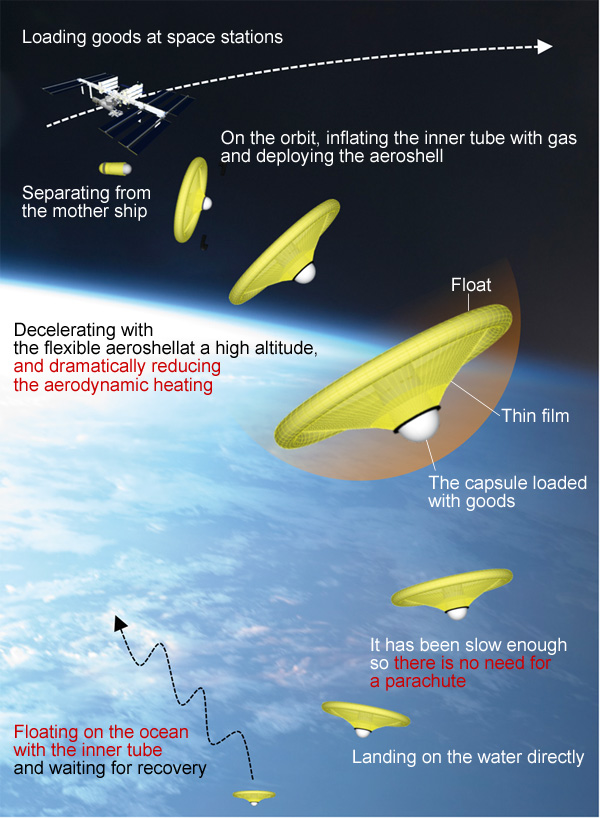
Why Is the Deployable Structure Necessary? One of the common big issues in space development is that all the things carried to the space have to be stored in a narrow rocket. Therefore, the size of the things to carry to the space is limited, which is a big restriction. Considering this point, things that can be folded and can expand, which is the so-called deployable structure, are useful in space development. Typical examples are the solar cell panels and the extendable antennas installed on the artificial satellites. In addition, the giant antenna installed on the Radio Astronomical Satellite HALCA, and the solar sail, which became well known due to the small solar-powered sailing demonstrator IKAROS, are both prime examples of the deployable structure. And this issue as well fits the vehicles to come back to the earth from the space. As everyone knows, there is nearly no air(atmosphere) in the space. However, it does not mean that we do not need to consider the atmosphere during exploring the space. Especially, when we come back to the earth from space, or when we explore astronomical objects with atmosphere such as Mars and Venus, we will not arrive at the destination until we pass through the atmosphere. Furthermore, we have to dive into the atmosphere with an extremely high speed. The vehicles entering the atmosphere have to decelerate using the aerodynamic drag force. To achieve this, it is beneficial to use a light giant vehicle, which can effectively use the aerodynamic force of the atmosphere. However, the size of atmospheric-entry vehicle is restricted by the size of the rockets. For the rockets to launch to the space, the aerodynamic drag force is a big obstacle, so the rockets are often made narrow and long. On the contrary, for the atmospheric-entry vehicles, it is necessary to decelerate using the air, we want to make them as wide as possible. So far, the atmospheric-entry vehicles have been developed by finding compromises which can meet such contradictory demands. One of the solutions to break through the restriction is to use deployable structure in designing the atmospheric-entry vehicles. That is to say, we fold the vehicle into a small size and store it in the rockets while launching, and deploy it into a big size while entering the atmosphere. With this concept, we may be able to make an atmospheric-entry vehicle with completely new features. It is during the development of the atmospheric-entry vehicle, which is equipped with the deployable aeroshell (a brake device using the aerodynamic drag force, which can decelerate like a parachute) as a result of the concept, when I received the 7th Encouragement Award of Space Science. The start of the development of the deployable atmosphere-entry vehicle, as well as its features, has been introduced in detail in the ISAS news October 2012 issue (No.379). With the help of the wind tunnel equipped in JAXA and the balloons and sounding rockets of ISAS, as well as the free thinking and decisive environment of the university, we succeeded in the reentry demonstration using a sounding rocket (S-310-41). All of these have been introduced in that article, so I recommend you to read through it. However, this technology, as written in that article, has only passed the midterm examination. Currently, we are going to start the preparations for the final graduation exams. In the latter half of this article, I will introduce the remaining technological problems and the process to apply this concept into the actual missions.
|
||||||