




TOP > Report & Column > The Forefront of Space Science > 2015 > New Concepts of the Atmospheric-entry Vehicles

 |
||||||

What Are the Tasks of the Final Exam? For the final exam of the research of the deployable aeroshell, we set up a task to build a vehicle to bring a small amount of goods (about 1kg, while the total weight of the vehicle is around 15kg) from the space (e.g. the orbit of the space station) back to the earth. If we succeeded in the experiment, we could use it to bring the results from small artificial satellites back to the earth. Suppose we are coming back from the space station, the speed while entering the atmosphere is estimated to be 8km/s (which was 1.32km/s during the sounding rocket experiment), the aerodynamic heating and the aerodynamic drag force will be much more severe compared to the sounding rocket experiment. To make it proof against such severe environment, it is necessary to improve the aeroshell made for the sounding rocket experiment further. To achieve that, there are 2 big issues. One is to make a bigger aeroshell with more precision, but without increasing too much weight, while the other one is to improve the heat-resisting property. These are the problems that we have to clear at least before facing the final exam. The purpose is to make a flexible aeroshell which can be infrangible against 150kg aerodynamic force with a diameter of 2.5 meters, and can survive in a environment with heat flux of 100kW/㎡. It is difficult to make an easy-to-understand explain for the heating condition, just imagine that the maximum surface temperature is around 1000°C. That means to make a “balloon�Ewhich does not leak air even if the surface is 1000°C. An aeroshell which is soft but tough Currently, we are conducting researches to solve these problems. Figure 2 is the prototype of the deployable aeroshell with a diameter of 2.5 meters during the wind tunnel experiments. You may find that the flexible aeroshell surrounded by inflatable ring like an inner tube is in a shape of a dodecagon. It is where we put our efforts in while making a precise three-dimensional shape using soft materials. With such a prototype, we did experiments to test the toughness against the aerodynamic force by exposing the aeroshell to the wind. As shown in the upper-right of figure 2, although the surface of the film was stretched by the aerodynamic force and changed into the shape of Mount Fuji, it succeeded to keep the form of an aeroshell. And we confirmed that it is possible to decelerate the reentry vehicle by generating strong aerodynamic force. We have confirmed that this prototype is able to be proof against an aerodynamic force of more than 200kg. However, if we give an aerodynamic force beyond expectation, it will be crushed like the lower-right of figure 2. Although the structure is able to be proof against an aerodynamic force of several hundred kilograms, from the crushed shape, we recognized that the flexible film was doing its best. Be doing such experiments again and again, we are improving the design of the deployable flexible aeroshell. 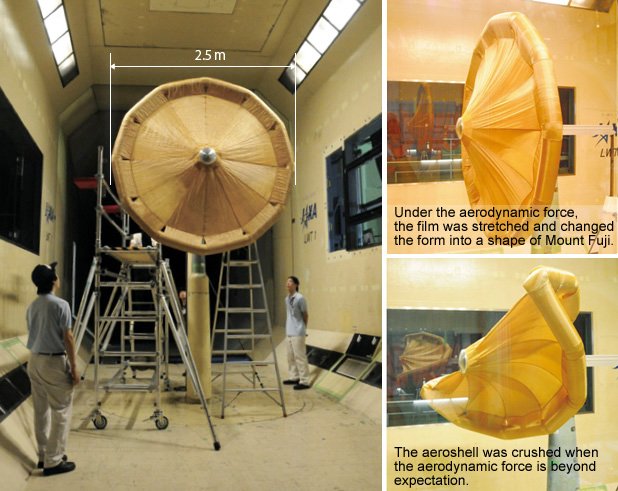
|
||||||